
The Use of Natural Ventilation in Jakarta: Is It Still Possible?
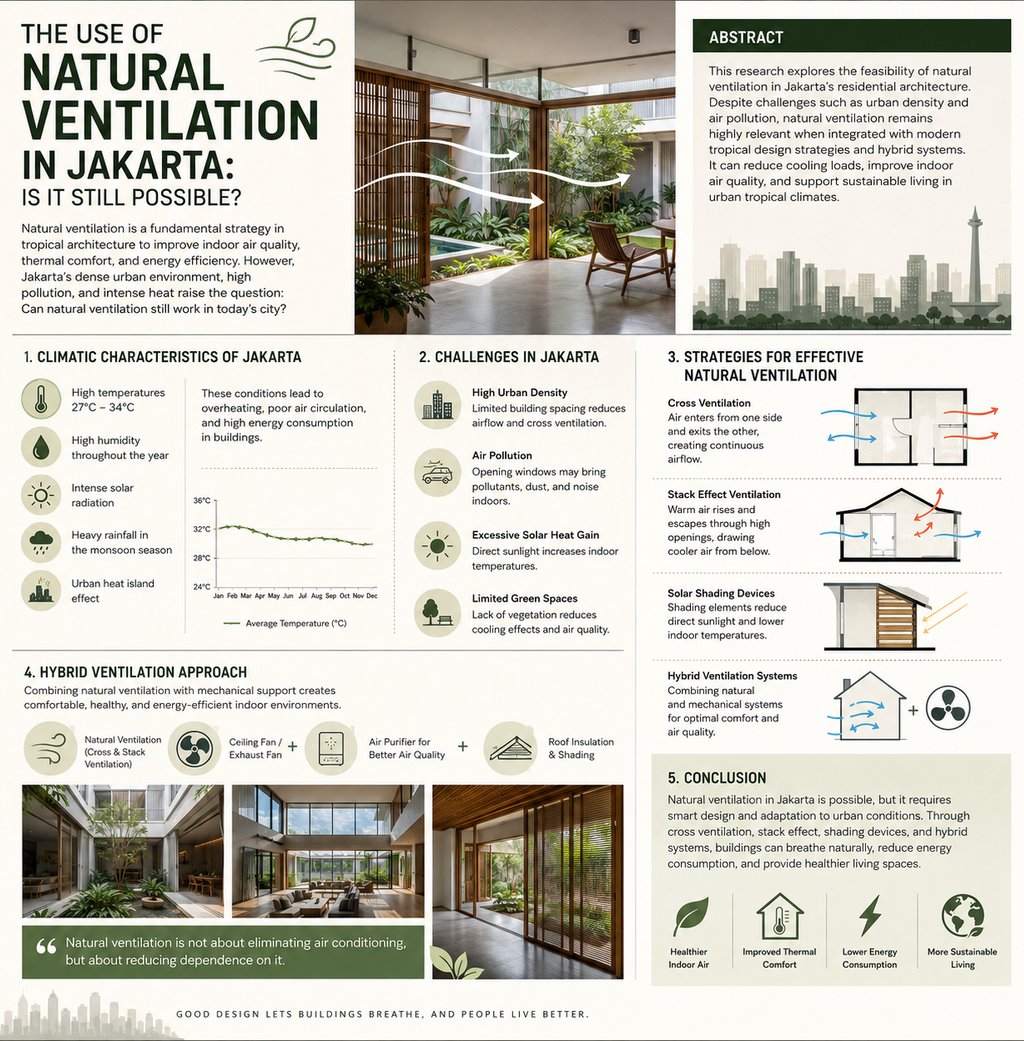
Natural ventilation in Jakarta remains possible despite the city’s hot, humid, and densely populated urban environment. This research discusses how modern tropical architecture can utilize strategies such as cross ventilation, stack effect, shading devices, and hybrid ventilation systems to improve thermal comfort and reduce energy consumption. Rather than fully replacing air conditioning, natural ventilation can serve as an effective passive design approach to create healthier, more sustainable, and energy-efficient living spaces in urban tropical climates.
5/19/20267 min read
Abstract
Jakarta, as one of the largest metropolitan cities in Southeast Asia, faces significant environmental challenges related to urban heat, air pollution, and high energy consumption. In response, natural ventilation has re-emerged as an important architectural strategy for creating healthier and more energy-efficient buildings in tropical urban environments. However, the effectiveness of natural ventilation in Jakarta remains questionable due to dense urban development, limited open spaces, and poor outdoor air quality. This paper discusses the feasibility of implementing natural ventilation in Jakarta’s residential architecture by analyzing climatic conditions, urban constraints, and contemporary tropical design strategies. The study concludes that while fully passive cooling may not always be achievable, natural ventilation remains highly relevant when integrated with modern tropical architectural approaches and hybrid ventilation systems.
1. Introduction
The rapid urbanization of Jakarta has significantly altered the city’s environmental conditions. High-density developments, reduced green spaces, and increasing dependence on mechanical cooling systems have contributed to elevated indoor temperatures and excessive energy consumption. As a tropical city with high humidity and year-round warm temperatures, Jakarta presents unique challenges for residential thermal comfort.
In recent years, sustainable architecture and passive cooling strategies have gained increasing attention. Among these strategies, natural ventilation is considered one of the most fundamental approaches in tropical architecture. Traditionally, Indonesian vernacular houses utilized large openings, elevated structures, and cross-ventilation systems to maximize airflow and thermal comfort.
However, the question remains:
Is natural ventilation still effective in Jakarta’s contemporary urban environment?
This paper aims to explore the relevance, limitations, and opportunities of natural ventilation in Jakarta from the perspective of modern tropical architecture.
2. Climatic Characteristics of Jakarta
Jakarta experiences a tropical humid climate characterized by:
Average temperatures between 27°C–34°C
High relative humidity levels
Intense solar radiation
Limited seasonal variation
Heavy rainfall during monsoon periods
In addition, Jakarta is heavily affected by the urban heat island phenomenon, where urban areas experience significantly higher temperatures than surrounding rural areas due to concrete surfaces, asphalt roads, and limited vegetation.
These climatic conditions create several challenges, such as: a) Overheating in indoor spaces; b) Increased dependence on air conditioning; c) Poor indoor air circulation; and d) High energy demand.
Consequently, residential buildings require design strategies that can improve airflow while minimizing heat gain.
3. The Concept of Natural Ventilation
Natural ventilation refers to the process of supplying and removing air through passive means without mechanical systems. It relies on pressure differences, wind movement, and thermal buoyancy to create airflow within a building.
In tropical architecture, natural ventilation plays a crucial role in achieving passive thermal comfort. The primary objectives of natural ventilation include:
Improving indoor air quality
Reducing indoor heat accumulation
Lowering humidity levels
Enhancing occupant comfort
Reducing energy consumption
4. Challenges of Natural Ventilation in Jakarta
Although natural ventilation is theoretically suitable for tropical climates, its application in Jakarta faces several urban constraints.
4.1 High Urban Density
One of the primary challenges of implementing natural ventilation in Jakarta is the city’s extremely high urban density. In many residential areas, houses are constructed with very limited distances between one another, often sharing walls or separated by only narrow alleys. This urban condition significantly restricts the movement of air and reduces the effectiveness of passive cooling strategies such as cross ventilation.
Cross ventilation relies on pressure differences between openings located on opposite sides of a building to create continuous airflow. However, in densely populated neighborhoods, surrounding buildings often block wind movement and reduce natural air circulation. As a result, indoor spaces become stagnant, humid, and thermally uncomfortable.
Furthermore, high-density developments frequently prioritize maximum land utilization over environmental performance. Many modern urban houses are designed with minimal openings for privacy and security reasons, unintentionally reducing opportunities for natural airflow.
The lack of adequate spacing between buildings also contributes to heat accumulation. Concrete walls and paved surfaces absorb solar radiation during the day and release heat at night, causing urban areas to remain warm even after sunset. This phenomenon intensifies indoor overheating and increases dependence on mechanical cooling systems such as air conditioning.
To address these issues, architects and designers must explore alternative ventilation strategies suitable for compact urban conditions. Solutions such as internal courtyards, vertical voids, ventilation shafts, and open-plan spatial arrangements can help improve airflow despite spatial limitations.
4.2 Air Pollution
Air pollution represents another major obstacle to the implementation of natural ventilation in Jakarta. The city consistently experiences poor outdoor air quality due to heavy traffic congestion, industrial emissions, construction activities, and urban dust particles. Natural ventilation systems depend on outdoor air entering the building through windows, vents, or other openings. However, in polluted urban environments, the incoming air may carry harmful pollutants, including:
Fine particulate matter (PM2.5 and PM10)
Vehicle exhaust emissions
Dust and allergens
Industrial pollutants
As a result, occupants may hesitate to open windows despite the need for ventilation, especially in houses located near busy roads or industrial areas. This creates a dilemma between achieving thermal comfort and maintaining healthy indoor air quality. In addition, polluted outdoor air can negatively affect interior surfaces, furniture, and mechanical equipment through dust accumulation and long-term contamination.
To overcome this challenge, contemporary tropical architecture increasingly adopts hybrid ventilation approaches. These include:
Combining natural ventilation with air filtration systems
Utilizing vegetation as environmental buffers
Positioning openings away from pollution sources
Incorporating semi-open transitional spaces
Using exhaust systems to improve indoor air circulation
Vegetation plays an important role in filtering dust and improving microclimatic conditions. Trees, green walls, and internal courtyards can act as natural filters while simultaneously reducing heat exposure. Therefore, natural ventilation in Jakarta must be carefully controlled and integrated with air quality management strategies rather than relying solely on unrestricted open airflow.
4.3 Excessive Solar Heat Gain
Excessive solar heat gain is one of the most critical environmental issues affecting residential comfort in Jakarta. Due to the tropical climate, buildings are exposed to intense solar radiation throughout the year, especially during midday and afternoon periods. Many contemporary residential buildings adopt minimalist architectural styles characterized by:
Large glass windows
Extensive curtain wall systems
Exposed facades
Minimal roof overhangs
Limited shading devices
While visually modern and aesthetically appealing, these design choices often increase indoor heat absorption. Glass surfaces allow significant solar radiation to penetrate interior spaces, causing indoor temperatures to rise rapidly. In poorly shaded buildings, heat becomes trapped within enclosed spaces, creating a greenhouse effect that reduces occupant comfort and increases dependence on air conditioning systems. Additionally, materials commonly used in urban housing, such as concrete, steel, and ceramic surfaces, possess high thermal mass, meaning they absorb and store heat during the day before releasing it slowly at night. This contributes to prolonged indoor warmth even after outdoor temperatures decrease.
To improve the effectiveness of natural ventilation, reducing solar heat gain is essential. Architectural strategies may include:
Deep roof overhangs
Vertical or horizontal shading fins
Secondary skin facades
Wooden louvers
Reflective materials
Vegetation shading systems
These passive design elements help reduce direct solar exposure while allowing airflow and daylight penetration. Ultimately, natural ventilation cannot function effectively if excessive heat continues entering the building. Therefore, thermal protection and ventilation strategies must work together as an integrated tropical design approach.
4.4 Limited Green Open Spaces
The limited availability of green open spaces in Jakarta significantly affects urban thermal comfort and the performance of natural ventilation systems. Rapid urban development has transformed many vegetated areas into dense residential and commercial zones dominated by concrete and asphalt surfaces. Vegetation plays a crucial role in regulating urban microclimates through:
Shading
Evapotranspiration
Heat absorption reduction
Air quality improvement
In areas with sufficient greenery, surrounding air temperatures are generally lower, creating more comfortable outdoor and indoor environments. However, the scarcity of trees and open green spaces in Jakarta reduces these natural cooling effects. As a consequence, many urban neighborhoods experience higher ambient temperatures and reduced air movement. Hard surfaces such as roads, parking areas, and building facades absorb and store solar heat, intensifying the urban heat island effect. The absence of vegetation also impacts air quality and humidity regulation. Without adequate plant coverage, dust particles and pollutants remain concentrated within urban areas, further reducing environmental comfort.
For naturally ventilated buildings, surrounding environmental conditions strongly influence indoor performance. Even well-designed ventilation systems may struggle to provide comfort if the outdoor environment itself is excessively hot and dry. To improve thermal conditions, architects and urban planners increasingly integrate greenery into residential design through:
Inner courtyards
Pocket gardens
Green roofs
Vertical gardens
Vegetated terraces
Shaded outdoor transitional spaces
These strategies not only improve aesthetics but also enhance airflow quality, reduce heat exposure, and support healthier living environments. In tropical urban contexts such as Jakarta, green infrastructure should be viewed as an essential component of passive environmental design rather than merely decorative landscaping.
5. Strategies for Effective Natural Ventilation in Jakarta
Despite these challenges, natural ventilation remains feasible when supported by appropriate architectural strategies.
5.1 Cross Ventilation
Cross ventilation is achieved by placing openings on opposite sides of a room or building to allow continuous airflow. This strategy:
Enhances air movement
Removes trapped heat
Improves thermal comfort
In compact urban houses, cross ventilation can be improved through:
Internal courtyards
Void spaces
Ventilation blocks
Open-plan layouts
5.2 Stack Effect Ventilation
The stack effect utilizes the principle that warm air rises naturally. Buildings with:
High ceilings
Vertical voids
Clerestory windows
Ventilated skylights
Can release accumulated hot air more effectively. This strategy is particularly useful in tropical climates where indoor heat accumulation is significant.
5.3 Solar Shading Devices
Controlling solar heat gain is essential for improving the effectiveness of natural ventilation. Architectural elements such as:
Secondary skins
Vertical fins
Deep overhangs
Wooden louvers
Vegetation screens
Can significantly reduce direct solar exposure. Lower indoor surface temperatures contribute to improved thermal comfort even with minimal mechanical cooling.
5.4 Hybrid Ventilation Systems
In Jakarta’s urban environment, fully passive cooling may not always be sufficient. Therefore, hybrid systems combining natural and mechanical ventilation are increasingly recommended. Examples include:
Natural ventilation with ceiling fans
Ventilation systems combined with exhaust fans
Air purifiers integrated with passive airflow
Natural ventilation supported by roof insulation
Hybrid approaches offer a practical balance between comfort, energy efficiency, and indoor air quality.
6. Discussion
The effectiveness of natural ventilation in Jakarta depends not only on climatic factors but also on architectural design decisions. Contemporary housing developments often prioritize aesthetics over environmental performance, resulting in poorly ventilated spaces. Modern minimalist designs frequently incorporate:
Sealed facades
Large glass openings
Low ceilings
Limited airflow paths
While visually appealing, these designs often increase indoor heat accumulation and dependence on air conditioning. In contrast, tropical modern architecture demonstrates that natural ventilation can still function effectively when integrated from the early design stage. Spatial organization, building orientation, material selection, and shading systems all contribute to overall thermal performance. Rather than eliminating air conditioning, natural ventilation should be viewed as a strategy to reduce cooling loads and improve indoor environmental quality.
7. Conclusion
Natural ventilation in Jakarta remains possible, but its implementation requires adaptation to contemporary urban conditions. Traditional passive cooling strategies alone may no longer be sufficient due to urban density, pollution, and excessive heat exposure.
However, through the integration of:
Cross ventilation systems
Stack effect principles
Solar shading devices
Hybrid mechanical support
Architects can still create residential environments that are healthier, more comfortable, and energy efficient. Ultimately, the future of tropical architecture in Jakarta lies not in completely abandoning mechanical cooling, but in designing buildings that can “breathe” naturally while minimizing environmental impact.
References
Givoni, B. (1998). Climate Considerations in Building and Urban Design. Wiley.
Olgyay, V. (2015). Design with Climate: Bioclimatic Approach to Architectural Regionalism. Princeton University Press.
Koenigsberger, O. H. et al. (1974). Manual of Tropical Housing and Building. Orient Blackswan.
Indonesian National Standard (SNI) on Natural Ventilation and Thermal Comfort.
Research on Urban Heat Island Effects in the Jakarta Metropolitan Area.
Contact
Reach out for bespoke design and build services
© 2026. All rights reserved.


Studio:
Jl. Pisang Kepok IV No. 24, Kota Baru, Bekasi Barat, Kota Bekasi 17133 - Indonesia
Headquarter:
Plaza Summarecon Bekasi, Lvl. 7
Jln. Bulevar Ahmad Yani Kav. K01., Harapan Mulya, Medan Satria, Kota Bekasi 17142 - Indonesia
Phone Number:
+62 817 0101 388
+62 821 2255 5520
e-mail:
glmindonesia19@gmail.com