
The Role of Biophilic Design in Modern Tropical Urban Living
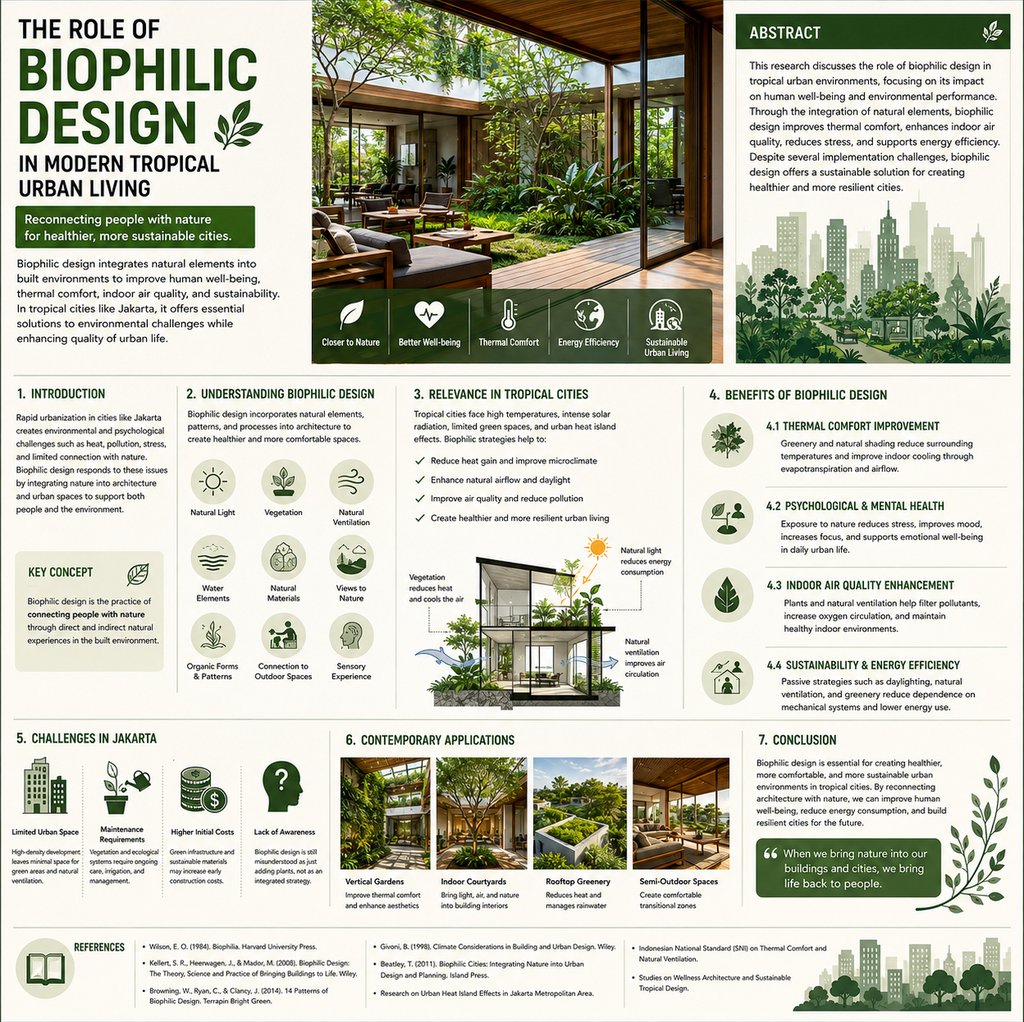
Biophilic design has become an increasingly important approach in modern tropical architecture, especially in densely populated cities such as Jakarta. By integrating natural elements like vegetation, natural lighting, airflow, and organic materials into built environments, biophilic architecture improves thermal comfort, indoor air quality, psychological well-being, and energy efficiency. This article explores how biophilic design can serve as a sustainable solution for healthier and more human-centered urban living in tropical metropolitan environments.
5/19/20269 min read
Abstract
Rapid urbanization in tropical metropolitan cities has created environmental and psychological challenges associated with high-density living, excessive heat, pollution, and limited interaction with nature. In response, biophilic design has emerged as a contemporary architectural approach that integrates natural systems into built environments to improve human well-being and environmental performance. This paper examines the role of biophilic design in tropical urban contexts, particularly in Jakarta, by analyzing its contributions to thermal comfort, sustainability, indoor air quality, and mental health. The study argues that biophilic design is no longer merely an aesthetic trend, but an essential environmental strategy for future urban living in tropical cities.
1. Introduction
The rapid growth of urban environments has significantly transformed the relationship between humans and nature. Cities such as Jakarta are increasingly dominated by high-rise buildings, concrete surfaces, heavy traffic, and artificial environments that limit daily interaction with natural systems. As a result, urban residents often experience:
Increased thermal discomfort
Poor indoor air quality
Psychological stress
Reduced physical activity
Mental fatigue caused by overstimulating urban environments
Urban living has also intensified environmental challenges, such as the urban heat island effect, in which dense city areas experience higher temperatures than surrounding rural regions due to excessive heat absorption by buildings and paved surfaces. In this context, architects and designers have increasingly explored biophilic design as a strategy to reconnect people with nature while improving the quality of urban life. The concept of biophilia was popularized by biologist Edward O. Wilson, who suggested that humans possess an inherent tendency to seek connections with natural environments and living systems.
Biophilic design translates this concept into architecture by integrating natural elements such as vegetation, daylight, airflow, water, and organic materials into the built environment. Unlike purely decorative landscaping, biophilic design seeks to create immersive spatial experiences that support both environmental performance and human well-being.In tropical urban contexts such as Jakarta, biophilic design has become increasingly relevant because it offers both passive environmental solutions and psychological benefits for urban populations living in dense metropolitan conditions.
2. Understanding Biophilic Design
Biophilic design refers to an architectural and environmental design approach that strengthens the relationship between humans and nature through direct and indirect natural experiences. According to Stephen Kellert’s framework, biophilic design includes:
Natural lighting
Ventilation and airflow
Vegetation
Water elements
Natural materials
Organic forms and patterns
Visual and physical connection to outdoor environments
The primary objective of biophilic design is not simply to insert plants into buildings, but to create environments that support human health both psychologically and physiologically. Research has shown that humans respond positively to natural environments because human evolution historically developed in close interaction with nature. Modern urban environments, however, often separate people from these natural conditions, contributing to stress and environmental discomfort.
Biophilic architecture, therefore, attempts to restore sensory connections to nature through:
Daylight exposure
Natural airflow
Greenery
Organic textures
Spatial openness
Acoustic comfort
Visual access to landscapes
The approach is increasingly used in residential, healthcare, hospitality, office, and public architecture as part of sustainable and wellness-oriented design practices.
3. Relevance of Biophilic Design in Tropical Cities
Biophilic design is particularly relevant in tropical cities because tropical climates naturally support passive environmental strategies such as natural ventilation, vegetation integration, and daylight optimization. Jakarta experiences:
High annual temperatures
Intense solar radiation
High humidity
Limited green open spaces
Increasing urban heat island effects
These environmental conditions contribute to overheating, excessive energy consumption, and declining urban comfort. Conventional urban development in Jakarta often prioritizes commercial efficiency and land maximization, resulting in:
Sealed glass facades
Minimal vegetation
Limited airflow
Reduced outdoor interaction
Consequently, many buildings become heavily dependent on air conditioning systems, increasing operational energy consumption and carbon emissions. Biophilic design addresses these issues by integrating passive environmental systems into architectural spaces. For example:
Vegetation reduces surrounding temperatures
Natural airflow improves indoor ventilation
Shading devices minimize solar heat gain
Water elements improve microclimatic cooling
Natural lighting reduces dependence on artificial illumination
Furthermore, studies in Jakarta-related biophilic developments suggest that integrating nature into urban architecture can improve environmental quality while supporting healthier lifestyles.
4. Benefits of Biophilic Design
4.1 Thermal Comfort Improvement
One of the most important advantages of biophilic design in tropical environments is its ability to improve thermal comfort through passive environmental strategies. Vegetation acts as a natural cooling mechanism by:
Providing shade
Reducing surface temperatures
Supporting evaporative cooling
Improving airflow quality
Green roofs, vertical gardens, internal courtyards, and shaded terraces can significantly reduce heat accumulation within buildings. Studies on urban heat islands also indicate that vegetated surfaces reduce solar absorption and stabilize temperature fluctuations. In tropical architecture, thermal comfort is strongly influenced by air movement and shading rather than low temperatures alone. Biophilic design enhances passive cooling by combining:
Cross ventilation
Natural shading
Vegetative buffers
Open transitional spaces
As a result, buildings require less mechanical cooling and achieve improved environmental performance.
4.2 Psychological and Mental Health Benefits
Urban lifestyles often expose individuals to constant sensory stimulation, noise, congestion, and psychological stress. Research consistently demonstrates that natural environments have restorative effects on human mental health. Biophilic spaces contribute to:
Stress reduction
Improved mood
Better cognitive performance
Increased productivity
Emotional relaxation
Exposure to greenery, natural textures, daylight, and outdoor views has been associated with lower anxiety levels and improved psychological well-being. Healthcare and hospitality projects increasingly implement biophilic principles because natural environments accelerate emotional and physical recovery processes. Studies related to healthcare landscapes also indicate that biophilic environments can positively influence healing and recovery experiences.
Additionally, younger urban populations increasingly prioritize wellness-oriented spaces that support emotional comfort and work-life balance. Contemporary architecture trends now position biophilic design as part of broader wellness architecture movements.
4.3 Indoor Air Quality Enhancement
Air quality has become a major concern in tropical metropolitan cities due to pollution, humidity, and limited ventilation quality. Biophilic design improves indoor air quality through:
Natural ventilation systems
Vegetation integration
Air filtration through plants
Reduced dependence on sealed environments
Plants contribute to improved indoor environments by absorbing certain airborne pollutants and increasing humidity balance. Meanwhile, natural ventilation strategies allow healthier airflow circulation when properly controlled. In tropical urban settings, indoor air quality is especially important because residents spend significant amounts of time indoors due to climate conditions and urban lifestyles. Modern biophilic interiors often combine:
Natural airflow
Open spatial arrangements
Vegetation
Air purification systems
To create healthier and more breathable indoor environments.
4.4 Sustainability and Energy Efficiency
Biophilic design strongly supports sustainable architecture by reducing environmental dependence on mechanical systems. Passive strategies such as:
Daylighting
Cross ventilation
Vegetation shading
Green roofs
Thermal buffering
Can significantly reduce building energy consumption. Studies on urban environmental resilience suggest that integrating greenery into architecture helps mitigate urban heat island effects while improving overall climate adaptation capacity. Furthermore, biophilic urbanism supports broader sustainability goals, including:
Carbon reduction
Biodiversity enhancement
Stormwater management
Urban resilience
In tropical cities where cooling demands are high throughout the year, energy-efficient passive design strategies become increasingly critical for future urban development.
5. Challenges of Implementing Biophilic Design in Jakarta
Despite its benefits, implementing biophilic design in Jakarta presents several practical and environmental challenges.
5.1 Limited Urban Space
One of the most significant challenges in implementing biophilic design within tropical metropolitan cities such as Jakarta is the scarcity of available urban space. Rapid urbanization and population growth have intensified land development, causing residential and commercial areas to become increasingly dense. As a result, many buildings are constructed with the primary objective of maximizing floor area and economic value rather than prioritizing environmental quality or human well-being. In many urban housing developments, plots are almost entirely occupied by built structures, leaving minimal room for:
Courtyards
Gardens
Green buffers
Open transitional spaces
Natural airflow corridors
This condition greatly limits opportunities to integrate biophilic elements that depend on spatial openness and interaction with nature. The absence of outdoor green areas also reduces access to daylight, ventilation, and passive cooling strategies that are essential in tropical climates. Furthermore, high-density urban environments often create physical barriers that obstruct natural airflow and sunlight penetration. Closely packed buildings can generate stagnant air zones and excessive heat accumulation, reducing the effectiveness of natural ventilation systems and creating uncomfortable indoor conditions.
Limited urban space also affects residents psychologically. Research suggests that restricted exposure to greenery and outdoor environments may contribute to increased stress, mental fatigue, and reduced emotional well-being in urban populations. To address these limitations, architects increasingly explore alternative forms of compact biophilic integration, such as:
Vertical gardens
Rooftop greenery
Indoor courtyards
Pocket gardens
Green walls
Semi-outdoor transitional spaces
These strategies allow biophilic principles to remain applicable even within highly constrained urban environments. However, successful implementation requires careful spatial planning and environmental integration from the earliest design stages.
5.2 Maintenance and Operational Challenges
Although biophilic design offers substantial environmental and psychological benefits, its long-term success heavily depends on proper maintenance and operational management. Unlike conventional architectural elements, biophilic systems involve living components and environmental processes that require continuous care and monitoring. Key maintenance requirements include:
Irrigation systems
Plant management
Drainage control
Environmental monitoring
Pest prevention
Lighting regulation for vegetation growth
Without proper maintenance, biophilic installations may deteriorate over time and negatively impact both building performance and aesthetics. For example, poorly maintained vegetation systems may lead to:
Water leakage
Root damage to building structures
Mold growth
Excessive humidity
Insect infestations
Unhealthy plant conditions
Similarly, inadequate drainage systems may cause water accumulation, structural deterioration, and interior moisture problems, particularly in tropical climates with heavy rainfall and high humidity levels. Operational challenges also arise from the need for interdisciplinary coordination between architects, landscape designers, engineers, and maintenance teams. Successful biophilic architecture requires environmental systems that function cohesively rather than independently.
In many urban projects, maintenance responsibilities are underestimated during the design phase. Developers often focus on visual impact during initial construction but fail to establish long-term operational strategies. Consequently, some biophilic spaces gradually lose functionality and become purely decorative elements without meaningful environmental performance. To ensure sustainability, modern biophilic projects increasingly incorporate:
Automated irrigation systems
Low-maintenance plant species
Smart environmental sensors
Sustainable drainage technologies
Modular green infrastructure systems
Ultimately, biophilic design should not be viewed as a static architectural feature, but as a dynamic environmental system that evolves and requires ongoing stewardship.
5.3 Higher Initial Costs
One of the most commonly cited barriers to implementing biophilic design is the perception of higher initial construction costs. Compared to conventional building systems, biophilic architecture often requires additional investment in:
Green infrastructure
Specialized materials
Environmental technologies
Irrigation systems
Structural reinforcement
Landscape integration
Sustainable construction methods
Features such as green roofs, vertical gardens, water elements, and advanced passive ventilation systems may significantly increase upfront development expenses. Additionally, biophilic projects frequently demand collaboration among multiple disciplines, including:
Architects
Landscape architects
Environmental consultants
Mechanical engineers
Sustainability specialists
This integrated design approach can increase planning complexity and professional service costs during early project stages. However, while initial expenses may be higher, long-term operational benefits often compensate for these investments over time. Biophilic buildings can contribute to:
Reduced energy consumption
Lower cooling costs
Improved indoor environmental quality
Increased occupant productivity
Enhanced property value
Better long-term environmental resilience
Studies on sustainable architecture indicate that buildings designed with passive environmental strategies often achieve significant operational savings through reduced dependence on mechanical systems. Furthermore, growing global awareness of sustainability and wellness-oriented architecture has increased market demand for environmentally responsive buildings. In many cases, biophilic developments gain competitive advantages due to their perceived lifestyle quality and environmental value. Therefore, biophilic design should be evaluated not only through short-term construction costs, but also through long-term economic, environmental, and social performance.
5.4 Misinterpretation of Biophilic Design
As biophilic design becomes increasingly popular within contemporary architecture and interior design trends, the concept is often misunderstood or superficially implemented. Many projects claim to apply biophilic principles simply by adding decorative plants or isolated greenery without addressing deeper environmental and sensory relationships between humans and nature. This superficial interpretation reduces biophilic design to a visual aesthetic rather than a comprehensive environmental strategy. True biophilic design involves the integration of multiple interconnected elements, such as:
Natural airflow
Daylight quality
Thermal comfort
Organic materials
Spatial openness
Acoustic balance
Visual connection to nature
Multisensory environmental experiences
Architectural discussions increasingly emphasize that biophilic design is not merely about “placing plants inside buildings,” but about creating environments that support human psychological and physiological well-being through meaningful interaction with natural systems. For example, a building filled with decorative greenery may still fail to achieve biophilic performance if it:
Lacks natural ventilation
Creates excessive heat gain
Uses artificial lighting exclusively
Ignores sensory comfort
Disconnects occupants from outdoor environments
Similarly, excessive commercialization of biophilic aesthetics sometimes prioritizes visual trends for social media appeal rather than genuine environmental functionality. Community discussions among architects and designers frequently critique these shallow interpretations, arguing that authentic biophilic architecture must address:
Environmental responsiveness
Human-centered spatial experience
Sustainability
Sensory diversity
Climatic adaptation
In tropical contexts such as Jakarta, successful biophilic design requires an integrated understanding of climate, urban conditions, and human behavior rather than decorative symbolism alone. Therefore, future biophilic architecture should move beyond aesthetic imitation and focus on creating truly restorative, environmentally adaptive, and human-centered living environments.
6. Contemporary Applications of Biophilic Design
Contemporary tropical architecture increasingly integrates biophilic principles through:
Vertical gardens
Indoor courtyards
Rooftop greenery
Semi-outdoor living spaces
Natural materials
Water features
Passive cooling systems
Several Jakarta-based studies and conceptual projects demonstrate how biophilic design can support tourism, healthcare, commercial, and residential architecture. Modern architects also combine biophilic concepts with minimalist contemporary aesthetics to create spaces that are:
Functional
Sustainable
Emotionally restorative
Environmentally responsive
The growing popularity of wellness-oriented architecture suggests that biophilic design will continue shaping future tropical urban environments.
7. Conclusion
Biophilic design represents an increasingly important architectural strategy for tropical urban living. In cities such as Jakarta, where environmental stress, heat, pollution, and density continue to rise, reconnecting architecture with nature offers both environmental and psychological benefits. Rather than functioning solely as a visual trend, biophilic design contributes to:
Thermal comfort
Indoor air quality
Mental well-being
Energy efficiency
Urban sustainability
Through the integration of passive environmental systems and natural experiences, biophilic architecture can help create healthier and more resilient urban environments.
As urbanization continues to accelerate globally, future tropical cities may increasingly rely on biophilic principles to create built environments that not only function efficiently but also support human well-being and ecological balance simultaneously.
References
Wilson, E. O. (1984). Biophilia. Harvard University Press.
Kellert, S. R., Heerwagen, J., & Mador, M. (2008). Biophilic Design: The Theory, Science and Practice of Bringing Buildings to Life. Wiley.
Browning, W., Ryan, C., & Clancy, J. (2014). 14 Patterns of Biophilic Design. Terrapin Bright Green.
Givoni, B. (1998). Climate Considerations in Building and Urban Design. Wiley.
Koenigsberger, O. H. et al. (1974). Manual of Tropical Housing and Building. Orient Blackswan.
Beatley, T. (2011). Biophilic Cities: Integrating Nature into Urban Design and Planning. Island Press.
Yeang, K. (2006). EcoDesign: A Manual for Ecological Design. Wiley-Academy.
Indonesian National Standard (SNI) on Thermal Comfort and Natural Ventilation.
Research on Urban Heat Island Effects in the Jakarta Metropolitan Area.
Studies on Wellness Architecture and Sustainable Tropical Design.
Contact
Reach out for bespoke design and build services
© 2026. All rights reserved.


Studio:
Jl. Pisang Kepok IV No. 24, Kota Baru, Bekasi Barat, Kota Bekasi 17133 - Indonesia
Headquarter:
Plaza Summarecon Bekasi, Lvl. 7
Jln. Bulevar Ahmad Yani Kav. K01., Harapan Mulya, Medan Satria, Kota Bekasi 17142 - Indonesia
Phone Number:
+62 817 0101 388
+62 821 2255 5520
e-mail:
glmindonesia19@gmail.com