
Optimizing Cross Ventilation in Homes to Reduce Energy Consumption Energy-Efficient Tropical Housing Strategy for the Future of Indonesia’s Property Sector
This article discusses how optimizing cross ventilation can become a design strategy that not only improves thermal comfort, but also creates new economic value for Indonesia’s design and build industry. Through a modern tropical architecture approach, homes can reduce dependence on air conditioning, lower operational costs, improve indoor air quality, and strengthen the attractiveness of green property markets.
5/8/2026
Abstract
Indonesia is entering a new era of residential development. Homes are no longer valued solely for their aesthetics and building size, but also for their ability to adapt to the tropical climate, improve energy efficiency, and enhance occupant comfort. Amid rising urban temperatures, increasing electricity costs, and growing awareness of sustainability, cross ventilation has emerged as one of the most promising design solutions for reducing residential energy consumption.
For investors, developers, and design-build companies, this concept opens major opportunities in the rapidly growing sectors of sustainable housing, green property, and climate-resilient development across Indonesia and Southeast Asia.
Introduction
Modern homes in tropical cities often face a unique paradox. The more enclosed a building becomes in pursuit of a “modern” appearance, the greater its dependence on air conditioning. As a result, electricity consumption rises, indoor spaces remain uncomfortable during power outages, and household operational costs continue to increase.
This phenomenon is becoming increasingly evident in Indonesia. Urban heat islands, dense residential areas, limited vegetation, and housing designs that fail to respond to wind direction have transformed many homes into “heat boxes” within the tropical climate.
Yet Indonesia possesses an extraordinary natural potential: a) Abundant sunlight; b) Consistent tropical wind patterns; and c) Humidity conditions that can be harnessed for passive cooling systems.
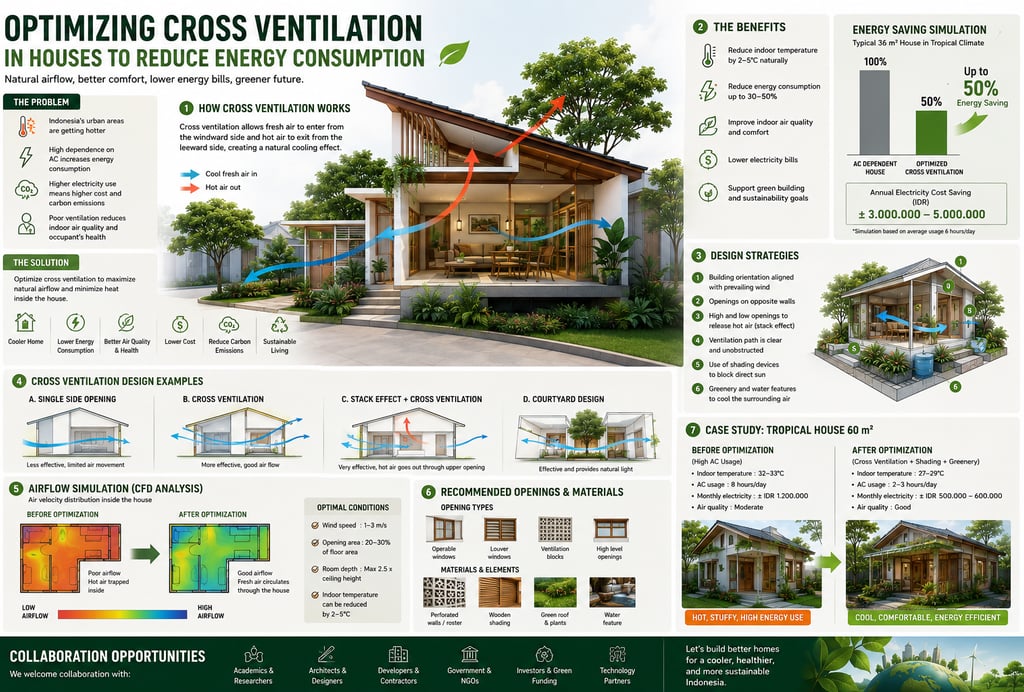
One of the most effective strategies is cross ventilation. Cross ventilation enables air to flow naturally from one side of a building to another, allowing indoor heat to escape without heavy reliance on air conditioning. Homes with optimized cross ventilation can reduce indoor temperatures by approximately 3–5°C and significantly lower cooling energy consumption.
Within Indonesia’s evolving property market, which is increasingly moving toward green buildings and sustainable housing, cross-ventilation-based housing design is no longer merely a traditional architectural approach. It is becoming a future-oriented business strategy.
Cross Ventilation and Energy Efficiency
Cross ventilation is a natural air circulation method that utilizes differences in air pressure between two sides of a building to create continuous airflow.
In simple terms: fresh air enters → hot air exits → indoor temperature decreases naturally.
This strategy works most effectively when: a) Openings are positioned on opposite sides of the building; b) Building orientation responds to prevailing wind directions; and c) Airflow pathways remain unobstructed.
Several studies indicate that opening configurations and natural ventilation significantly influence the reduction of building cooling loads.
In tropical climates such as Indonesia, cross ventilation offers substantial benefits: a) Reducing air conditioner usage; b) Improving indoor air quality; c) Minimizing humidity levels; d) Reducing mold risk; and e) Enhancing occupants’ thermal comfort.
Therefore, cross ventilation is not merely a technical feature, but a design asset that increases residential value.
Why Is This Topic Attractive for Financial Funding?
Today, global investors and funding institutions are highly interested in projects located at the intersection of: a) Sustainability; b) Affordable housing; c) Climate adaptation; d) Energy efficiency; and e) smart living.
Cross ventilation addresses all of these aspects:
A. Supporting Carbon Emission Reduction
Buildings are among the largest contributors to urban energy consumption. Reducing air conditioner usage directly contributes to lowering urban carbon emissions.
B. Aligning with Green Building Agendas
Indonesia’s property market is showing increasing interest in green buildings and sustainable housing developments.
C. Delivering Strong Social Impact
Energy-efficient homes help households reduce monthly electricity expenses, especially for middle-income urban families and subsidized housing sectors.
D. Offering High Scalability Potential
Cross ventilation concepts can be implemented across: a) Subsidized housing; b) Residential clusters; c) Incremental housing; d) Tiny houses; and e) Smart housing developments.
This scalability is one reason why green investors and climate funding institutions are increasingly interested in the sustainable housing sector.
Major Opportunities for Indonesia’s Design and Build Industry
Indonesia’s design and build market is currently undergoing a major transformation. Clients are no longer searching only for “beautiful” houses, but for homes that are: a) Cool; b) Healthy; c) Energy-efficient; d) Aesthetically appealing; and e) Capable of maintaining long-term investment value.
Cross ventilation is becoming a new selling point within the architecture and construction industry.
Why Clients Prefer This Concept
A. Lower Electricity Bills
Homes with optimized cross ventilation can significantly reduce air conditioner usage.
B. Healthier Living Environments
Natural airflow improves indoor air quality while reducing excess humidity.
C. Tropical Modern Aesthetics Are Trending
Modern tropical designs featuring large openings, ventilation blocks, inner courts, and semi-open spaces are increasingly popular in Indonesia’s residential market.
D. Higher Property Competitiveness
Green homes and energy-efficient housing continue to gain stronger market value within the modern property industry.
Effective Cross Ventilation Design Strategies
A. Opposing Openings Placement:
Windows and doors should be positioned on opposite sides to create continuous airflow.
B. Building Orientation Optimization:
Homes should adapt to local prevailing wind directions to maximize natural airflow performance.
C. Use of Voids and Inner Courts:
Voids help release hot air upward while improving vertical air circulation.
D. Secondary Skin and Shading Systems:
Canopies, louvers, and vegetation reduce direct solar heat without obstructing airflow.
E. Porous and Reflective Materials:
Materials with heat-reflective properties help maintain lower indoor temperatures.
Economic Impact and Property Market Potential
In the coming years, energy-efficient homes are likely to become the new standard within Indonesia’s urban property market. Younger generations of homebuyers are increasingly considering: a) Sustainability; b) Household operational costs; c) Healthy indoor environments; and d) Overall quality of life.
This means that design and build companies that develop expertise in energy-efficient tropical housing at an early stage will have a strong opportunity to become market leaders. Cross ventilation can serve as: a) a design differentiation strategy; b) a branding advantage; c) a project selling point; and d) a defining identity for modern design-build companies.
Conclusion
Cross ventilation is no longer merely a traditional architectural element. It is becoming a future-oriented strategy for creating tropical homes that are healthy, energy-efficient, and highly valuable. In an era shaped by urban heat, rising energy costs, and growing sustainability awareness, naturally ventilated homes offer solutions that are environmentally relevant while also economically beneficial. For financial funding institutions, this topic is attractive because it: a) Creates social impact; b) Supports carbon reduction goals; c) Offers strong scalability; and d) Aligns with global sustainability agendas.
For Indonesia’s design and build industry, cross ventilation creates new opportunities to develop: a) Premium tropical homes; b) Energy-efficient housing; c) Green residential developments; and d) Future-ready property projects that are more adaptive to climate conditions.
The future of Indonesia’s tropical housing may no longer depend on increasingly energy-intensive air conditioning systems. That future may begin with homes capable of “breathing” naturally with their surrounding environment.
Keywords
Cross ventilation, energy-efficient homes, sustainable housing, tropical architecture, green building, design and build Indonesia, urban heat, passive cooling, energy efficiency, smart housing.
Contact
Reach out for bespoke design and build services
© 2026. All rights reserved.


Studio:
Jl. Pisang Kepok IV No. 24, Kota Baru, Bekasi Barat, Kota Bekasi 17133 - Indonesia
Headquarter:
Plaza Summarecon Bekasi, Lvl. 7
Jln. Bulevar Ahmad Yani Kav. K01., Harapan Mulya, Medan Satria, Kota Bekasi 17142 - Indonesia
Phone Number:
+62 817 0101 388
+62 821 2255 5520
e-mail:
glmindonesia19@gmail.com