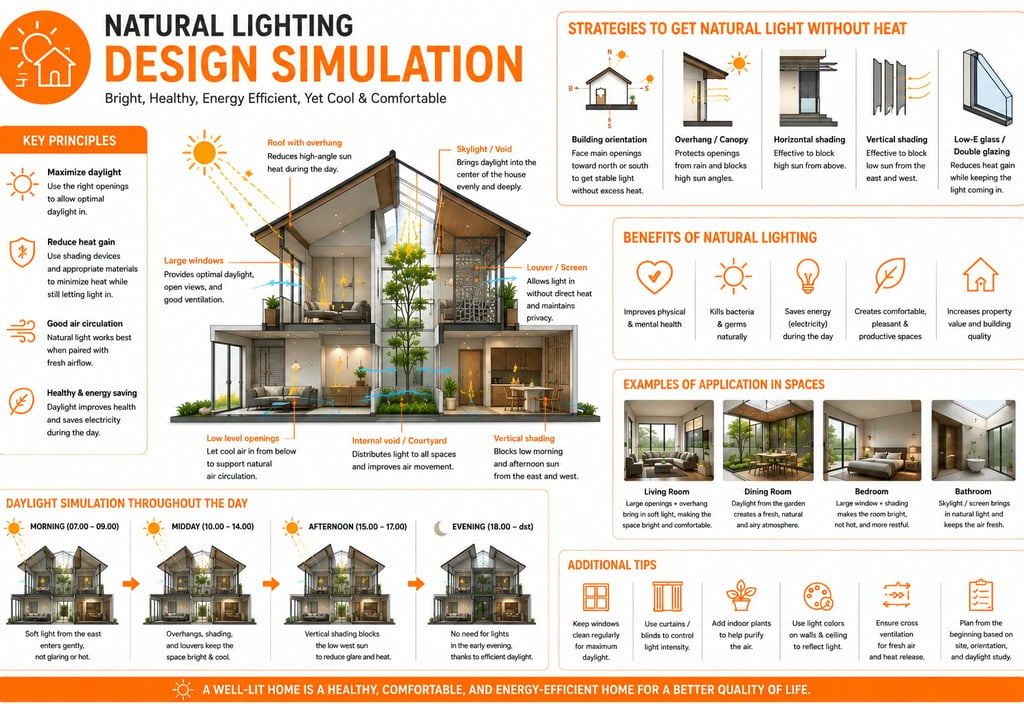
A home with good natural lighting should never be confused with one that simply lets in as much sunlight as possible. Uncontrolled sunlight often leads to glare, overheating, and discomfort—especially in tropical climates. In well-considered architecture, daylight is not just increased, but carefully shaped and moderated. The objective is to bring in enough natural light to create bright, inviting, and energy-efficient spaces, while maintaining a stable and comfortable indoor temperature.
Achieving this balance requires deliberate design decisions from the earliest stages. The orientation of the building plays a crucial role, determining how sunlight enters throughout the day. Openings placed on the north and south facades (in equatorial regions) tend to receive more consistent and manageable light, while east and west exposures often require additional protection due to low-angle, high-intensity sun. This is where architectural elements such as overhangs, fins, louvers, and canopies become essential—not as decorative features, but as functional filters that control solar penetration and reduce heat gain.
Ventilation strategies are equally important in complementing daylighting. Cross ventilation allows fresh air to move through the space, removing trapped heat and maintaining thermal comfort without relying heavily on mechanical cooling. When paired with shaded openings, this creates an environment that feels naturally cool and breathable. The choice of materials also contributes significantly—high-performance glazing, tinted or low-emissivity glass, and reflective surfaces can admit light while limiting unwanted heat.
Beyond physical comfort, well-managed daylight has a profound impact on how a space is experienced. It reduces reliance on artificial lighting, lowers energy consumption, and creates a dynamic indoor atmosphere that changes subtly throughout the day. Soft, diffused light improves visual comfort by minimizing glare and harsh contrasts, while also supporting better indoor air quality by reducing dampness and humidity. These conditions contribute to healthier living environments and can positively influence mood, productivity, and overall well-being.
In more advanced applications, daylighting is integrated with passive design strategies to enhance performance even further. Courtyards can draw light deep into the interior while promoting air movement, skylights can introduce controlled top lighting without excessive heat, and elements like secondary skins or ventilation blocks (roster) help scatter light evenly across surfaces. Rather than allowing sunlight to dominate the space, these features transform it into a more balanced and comfortable experience.
A home designed with this level of consideration evolves naturally over time—welcoming soft morning light, staying cool during peak heat, and maintaining efficiency throughout the day. In this sense, natural lighting becomes more than a visual feature; it is a core component of sustainable and human-centered design. When handled with precision, it elevates not only the performance of the building, but also the everyday quality of life within it.