
Mitigating Fire Risk in Informal Settlements: Strategies for Improving Safety and Resilience in High-Density Urban Areas
This research focuses on identifying and mitigating fire risks in informal settlements, which are highly vulnerable due to dense housing patterns, combustible building materials, inadequate infrastructure, unsafe electrical systems, and limited emergency accessibility. The study examines the relationship between physical, social, and environmental factors that contribute to fire incidents and proposes integrated mitigation strategies through urban upgrading, infrastructure improvement, community participation, technological interventions, and sustainable neighborhood development. The research aims to develop a comprehensive framework that enhances safety, reduces disaster vulnerability, and supports the transformation of informal settlements into resilient and sustainable communities.
5/25/20266 min read
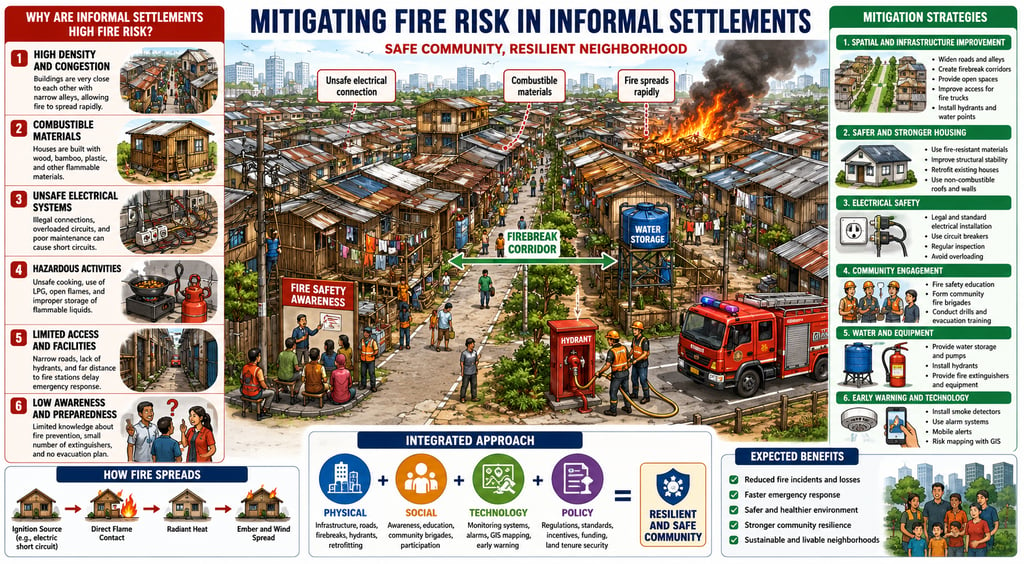
Fire disasters in informal settlements represent one of the most persistent urban safety challenges, particularly in rapidly urbanizing regions where population growth exceeds the capacity of infrastructure development and formal housing provision. Informal settlements—often characterized by dense building arrangements, inadequate utility systems, limited road access, and the use of combustible materials—create conditions that significantly increase both the probability of fire occurrence and the severity of resulting impacts.
Unlike conventional urban neighborhoods, informal settlements frequently develop without compliance with building regulations, fire safety standards, or integrated infrastructure planning. Consequently, a small ignition source, such as an electrical short circuit, gas leakage, or open cooking flame, may escalate into large-scale urban fires within minutes. The socio-economic consequences extend beyond physical destruction, affecting livelihoods, public health, social stability, and long-term community resilience.
This research investigates the underlying factors contributing to fire vulnerability in informal settlements and evaluates mitigation strategies applicable to high-density urban environments. The article adopts a qualitative literature review approach, integrating concepts from urban planning, disaster management, sustainable development, and community resilience frameworks. Particular emphasis is placed on preventive measures, spatial interventions, infrastructure enhancement, public participation, and policy integration.
The study concludes that effective fire mitigation requires a multidimensional and interdisciplinary approach involving government institutions, local communities, urban planners, engineers, and emergency agencies. Sustainable neighborhood development and participatory upgrading programs are identified as critical components for reducing fire risks and improving urban resilience.
Keywords: Informal settlements, fire mitigation, urban resilience, disaster management, sustainable neighborhood, risk reduction
Abstract
1. Introduction
Urban expansion and migration toward metropolitan areas have intensified the development of informal settlements across many developing countries. Limited affordable housing supply, economic inequality, and inadequate urban planning systems often force low-income populations to occupy marginal land areas and construct self-built housing with minimal infrastructure support. Informal settlements, commonly referred to as slum areas or unplanned neighborhoods, generally emerge outside formal planning regulations. Their growth is often organic and unregulated, leading to complex spatial arrangements that increase environmental and disaster vulnerabilities.
Among various urban hazards, fire remains one of the most destructive threats due to its rapid propagation characteristics. Fire incidents in these areas frequently result in catastrophic losses because of: a) Extremely narrow access roads; b) High concentrations of combustible structures; c) Illegal or unsafe electrical installations; d) Absence of firefighting infrastructure; and e) Limited emergency preparedness.
The risk becomes more severe when settlements are located near industrial areas, fuel storage zones, markets, or densely populated commercial districts. In such environments, fires can spread through conductive heat transfer, direct flame contact, wind-driven ember transport, and continuous combustible surfaces.
Furthermore, climate variability and increasing temperatures may exacerbate fire conditions by reducing moisture levels in surrounding materials and increasing energy consumption loads.
This study aims to:
Identify the primary drivers of fire risk in informal settlements.
Analyze structural and social vulnerabilities.
Evaluate mitigation strategies from urban, technical, and community perspectives.
Develop an integrated framework for sustainable fire risk reduction.
2. Introduction
2.1 High Building Density and Spatial Congestion
One of the defining features of informal settlements is the extremely close proximity between structures. Houses are often constructed with little or no setback distance, resulting in continuous building masses that enable rapid flame transmission. In many settlements, inter-building spacing may be less than one meter. This creates conditions where thermal radiation and direct flame exposure easily ignite neighboring structures.
Spatial congestion also limits: a) Firefighter movement; b) Evacuation efficiency; c) Equipment deployment; and d) Temporary shelter placement. Additionally, vertical extensions added without structural planning increase fire loads and evacuation complexity.
2.2 Use of Combustible Construction Materials
Economic limitations frequently lead residents to utilize locally available or recycled materials, including: a) Timber planks; b) Bamboo panels; c) Plastic sheeting; d) Tarpaulin roofing; and e) Scrap metal components. While cost-efficient, these materials generally possess: a) Low ignition temperatures; b) Limited fire resistance; and c) High heat release rates.
The accumulation of combustible materials increases fire intensity and accelerates structural collapse. Mixed-material construction further complicates suppression efforts because different materials exhibit varying combustion behaviors.
2.3 Unsafe Utility Infrastructure
Electrical systems in informal settlements often develop incrementally without professional supervision.
Common issues include: a) Illegal power tapping; b) Overloaded circuits; c) Exposed conductors; d) Improper cable insulation; and e) Shared distribution systems. These conditions increase the likelihood of: a) Electrical arcing; b) Short circuits; c) Overheating; and d) Equipment failure. Cooking activities also contribute significantly to fire initiation. The use of portable gas cylinders, charcoal stoves, and open flames within confined spaces elevates ignition potential.
2.4 Limited Emergency Accessibility
Road networks in informal settlements are typically narrow and discontinuous. Many pathways permit only pedestrian movement, preventing access for: a) Fire engines; b) Ambulances; and c) Rescue vehicles.
The absence of hydrants and water reservoirs further delays firefighting operations. Emergency response efficiency depends heavily on: Response Time = Distance + Accessibility + Equipment Availability
Poor accessibility increases operational delays and allows fires to grow beyond controllable stages.
2.5 Socioeconomic Vulnerability
Fire risk is not solely a physical issue; it is closely linked to socioeconomic conditions. Low-income households often prioritize immediate survival needs over long-term safety investments. Consequently, a) Maintenance is postponed; b) Safety equipment is absent; and c) Building upgrades are limited.
Educational constraints may also reduce awareness regarding fire prevention and emergency procedures.
3. Methodology
This research adopts a qualitative methodology using literature review and conceptual analysis.
Sources include: a) Academic journal articles; b) Urban planning studies; c) Disaster risk reports; d) Government publications; e) International fire safety guidelines. The research process consists of four stages:
Stage 1: Hazard Identification
Potential ignition sources were identified through previous fire incident analyses. Examples include: a) Electrical failures; b) Cooking accidents; c) Gas leaks; d) Open burning activities.
Stage 2: Vulnerability Analysis
Physical, social, and infrastructure weaknesses were evaluated. Indicators include: a) Population density; b) Housing conditions; c) Accessibility; and d) Utility quality.
Stage 3: Strategy Assessment
Existing mitigation programs from various countries were reviewed. Approaches analyzed: a) Settlement upgrading; b) Community firefighting systems; and c) Infrastructure retrofitting.
Stage 4: Framework Development
Findings were synthesized into an integrated mitigation model emphasizing sustainability and resilience.
4. Fire Risk Assessment Framework
Fire risk can be conceptualized using: Risk = Hazard × Vulnerability × Exposure
Where:
Hazard
Refers to fire ignition potential arising from: a) Electrical systems; b) Cooking activities; c) Fuel storage; and d) Open flames.
Vulnerability
Represents conditions that increase damage susceptibility: a) Poor housing quality; b) Lack of infrastructure; and c) Weak preparedness.
Exposure
Measures assets and population potentially affected. Examples: a) Household concentration; b) Economic activity density; and c) Public facilities.
Risk levels may be classified as:
a) Low -> Controlled infrastructure
b) Moderate -> Partial safety measures
c) High -> Dense settlements
d) Extreme -> Severe overcrowding
5. Mitigation Strategies
5.1 Spatial Reorganization and Settlement Upgrading
Urban restructuring represents one of the most effective long-term interventions. Key actions include:
Firebreak Corridors
Creating separation spaces reduces flame spread. Functions: a) Interrupt combustion pathways; b) Improve evacuation; and c) Facilitate emergency access
Road Improvement
Recommended widths: a) Primary access: 4–6 m; and b) Secondary access: 3 m minimum.
Open Space Development
Pocket parks and community plazas serve as: a) Refuge areas; b) Assembly points; and c) Heat buffers.
5.2 Building Retrofitting and Material Improvement
Structural upgrading may include: a) Fire-resistant wall systems; b) Non-combustible roofing; and c) Thermal insulation layers.
Recommended replacements:
a) Bamboo -> Fiber cement
b) Timber -> Concrete panel
c) Plastic -> Gypsum
Retrofitting programs should prioritize affordability. Micro-financing mechanisms may support implementation.
5.3 Electrical Safety Programs
Technical improvements include: a) Standardized wiring systems; b) Residual current devices; and c) Circuit protection units. Inspection schedules should be implemented periodically. Training topics: a) Safe appliance use; b) Load management; and c) Cable maintenance.
5.4 Community Participation
Community engagement improves early response effectiveness. Programs:
Fire Safety Education
The topics: a) Hazard identification; b) Safe cooking; and c) Evacuation procedures.
Volunteer Brigades
Roles: a) Initial suppression; b) Communication; anc c) Evacuation assistance.
Local participation reduces dependence on external responders.
5.5 Water Infrastructure Enhancement
Water availability determines suppression success. Recommended systems: a) Elevated storage tanks; b) Rainwater harvesting; and c) Decentralized hydrants. Distributed infrastructure reduces response delays.
5.6 Technology Integration
Emerging technologies include: a) Smoke detectors; b) Thermal sensors; c) GIS risk mapping; and d) Mobile alerts. Digital systems support: a) Early warning; b) Incident monitoring; and c) Data-driven planning.
6. Sustainable Fire Mitigation Through Green Neighborhood Development
Fire mitigation should align with sustainability objectives. Green neighborhood principles provide co-benefits:
Environmental
a) Reduced heat islands; c) Better ventilation; and d) Improved microclimate.
Social
a) Public gathering areas; and b) Safer evacuation routes.
Economic
a) Lower reconstruction costs; and b) Increased property resilience
Green corridors may function simultaneously as: a) Firebreaks; b) Drainage channels; and c) Recreational spaces.
7. Challenges and Limitations
Implementation faces several barriers:
Financial
Upgrading costs often exceed household capacity.
Institutional
Coordination among agencies remains fragmented.
Legal
Unclear land tenure discourages investment.
Social
Residents may resist relocation or restructuring.
Technical
Existing density limits intervention options.
8. Integrated Fire Risk Reduction Model
The proposed framework includes four dimensions:
Physical Dimension
Infrastructure upgrading, roads, hydrants, retrofitting
Social Dimension
Awareness, education, volunteer groups
Technological Dimension
Monitoring systems, GIS, alarms
Policy Dimension
Regulations, subsidies, incentives
The integration of these components creates adaptive urban resilience.
9. Conclusion
Fire risk in informal settlements is a complex interaction between physical conditions, infrastructure deficiencies, social vulnerability, and governance limitations. Conventional emergency response alone cannot sufficiently address these challenges. A comprehensive mitigation strategy must integrate settlement upgrading, safer construction practices, utility improvements, community participation, technological systems, and sustainable urban planning approaches. Future research should focus on quantitative modeling, GIS-based vulnerability mapping, and performance evaluation of upgrading programs in high-density neighborhoods to strengthen evidence-based fire risk management.
References
UN-Habitat. The Challenge of Slums: Global Report on Human Settlements.
World Bank. Upgrading Informal Settlements and Urban Resilience.
NFPA. Fire Safety Guidelines for High-Density Communities.
ISO 31000 Risk Management Framework.
UNDRR. Disaster Risk Reduction Strategy.
WHO. Urban Health and Environmental Resilience.
OECD. Urban Risk and Sustainable Development Policies.
IFRC. Urban Fire Disaster Reduction Manual.
Contact
Reach out for bespoke design and build services
© 2026. All rights reserved.


Studio:
Jl. Pisang Kepok IV No. 24, Kota Baru, Bekasi Barat, Kota Bekasi 17133 - Indonesia
Headquarter:
Plaza Summarecon Bekasi, Lvl. 7
Jln. Bulevar Ahmad Yani Kav. K01., Harapan Mulya, Medan Satria, Kota Bekasi 17142 - Indonesia
Phone Number:
+62 817 0101 388
+62 821 2255 5520
e-mail:
glmindonesia19@gmail.com