
House Foundation Simulation: Strong & Durable Design
The Essential Base for a Safe, Stable, and Long-Lasting Home. The foundation is the most fundamental part of any building. Although it is no longer visible once construction is complete, it plays a critical role in ensuring the strength, stability, and longevity of a house. Even the most beautifully designed home can suffer from cracks, tilting, or even structural failure if the foundation is not properly planned and constructed. In Indonesia, where soil conditions vary widely and seismic activity is a constant risk, foundation design must be carefully tailored to soil characteristics, structural loads, and environmental conditions. A foundation is not merely a substructure—it is the “root” of the building that determines its long-term safety and performance.
5/11/202610 min read
Main Functions of a House Foundation
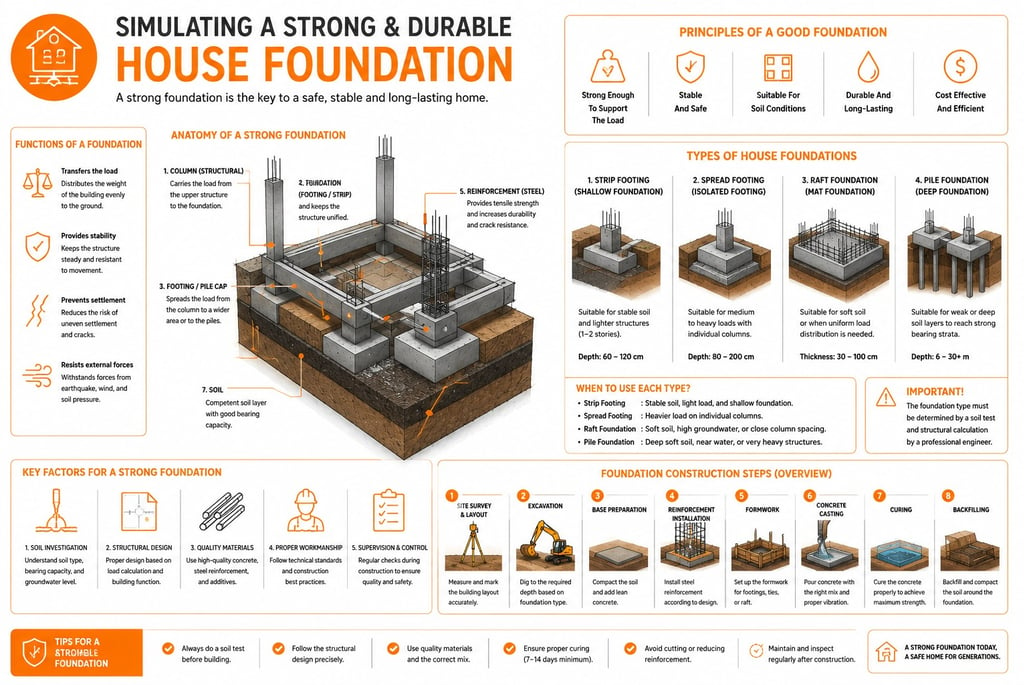
The main functions of a house foundation go far beyond simply “holding up” a building. A well-designed foundation acts as the critical interface between the structure and the ground, ensuring safety, durability, and long-term performance. In short, the foundation is not just a base—it is a system that ensures the building performs safely, efficiently, and sustainably over time. A mistake at this level is difficult and costly to correct, which is why careful planning, soil investigation, and proper construction are essential from the very beginning. A foundation serves several essential purposes, such as:
Load Distribution
The primary function of a foundation is to transfer and distribute the building’s loads—both dead loads (weight of the structure itself) and live loads (people, furniture, wind, etc.)—evenly to the soil beneath. Without proper distribution, the soil can become overstressed, leading to uneven settlement, cracks, or even structural failure.Structural Stability
A foundation anchors the house firmly to the ground, preventing movement caused by lateral forces such as wind, earthquakes, or soil shifts. It ensures the building remains stable and upright over time, especially in regions prone to seismic activity or strong environmental forces.Prevention of Settlement Issues
Different soil types behave differently under load. A good foundation system minimizes differential settlement (uneven sinking), which is one of the most common causes of cracks in walls, floors, and structural elements. Proper design considers soil capacity, moisture content, and compaction.Moisture and Groundwater Protection
Foundations act as a barrier against moisture rising from the ground (capillary action) and groundwater intrusion. This is crucial in preventing dampness, mold growth, and material deterioration, especially in humid tropical climates.Leveling and Surface Preparation
The foundation provides a flat and level base for construction. This ensures that all structural and architectural elements above—columns, walls, floors—are aligned properly, which directly affects construction quality and finishing precision.
Thermal and Environmental Buffer
In some designs, foundations help regulate indoor temperature by reducing heat transfer from the ground. They can also contribute to energy efficiency when combined with insulation and proper material selection.
Durability and Longevity of the Building
A strong foundation increases the lifespan of a house. By protecting the structure from ground movement, moisture, and environmental stresses, it ensures that the building remains safe and functional for decades.
Characteristics of a Strong and Reliable Foundation
A strong and reliable foundation isn’t defined by size alone—it’s defined by how well it responds to soil conditions, loads, and environmental factors over time. Many foundation failures happen not because the structure was “too small,” but because it was poorly matched to its context. In essence, a strong foundation is not just “solid”—it is well-designed, context-aware, and carefully executed. It works quietly beneath the surface, but its impact defines the safety and longevity of the entire building.
Adequate Load-Bearing Capacity
A good foundation must safely support all structural loads without exceeding the soil’s bearing capacity. This requires proper soil investigation and engineering calculations to ensure the ground can handle the weight without excessive settlement.
Uniform Settlement Performance
Some settlement is normal, but it must occur evenly. A reliable foundation minimizes differential settlement (uneven sinking), which can cause cracks in walls, misaligned doors/windows, and long-term structural issues.
Proper Depth and Soil Engagement
The depth of the foundation should reach stable soil layers, avoiding loose or highly compressible materials. In certain cases, deeper systems like piles are needed to transfer loads to more competent strata.
Structural Strength and Reinforcement
The foundation must be designed with sufficient strength to resist bending, shear, and tension forces. This typically involves reinforced concrete with proper detailing, ensuring it can handle both vertical and lateral loads.
Resistance to Moisture and Water Damage
A durable foundation includes protection against groundwater, rain infiltration, and capillary rise. Waterproofing layers, drainage systems, and proper site grading are key to preventing long-term deterioration.
Stability Against Lateral Forces
Beyond vertical loads, foundations must resist horizontal forces such as soil pressure, wind, and seismic activity. This ensures the building remains stable and does not shift or tilt over time.
Good Construction Quality and Workmanship
Even the best design can fail with poor execution. Proper compaction, accurate dimensions, correct reinforcement placement, and quality concrete curing all play a major role in foundation performance.
Adaptability to Environmental Conditions
A strong foundation responds to its environment—whether it’s expansive clay, high groundwater levels, flood-prone areas, or tropical climates. The design should anticipate these conditions rather than react to problems later.
Long-Term Durability
Materials and construction methods should resist aging, corrosion, and environmental exposure. A reliable foundation maintains its performance for decades with minimal maintenance.
Effective Drainage System
Water is one of the main threats to foundation integrity. Poor drainage can weaken the supporting soil. A proper system should include: a) Water channels; b) Drainage systems; and c) Rainwater management.
Types of
House Foundations
There isn’t a single “best” type of house foundation—the right choice depends on soil conditions, climate, building load, and budget. What matters is selecting a system that responds appropriately to the site, rather than forcing a standard solution onto every project. In practice, choosing the right foundation should always start with a soil investigation (geotechnical study). Skipping this step often leads to overdesign (wasting cost) or underdesign (risking failure). A well-matched foundation system ensures not only structural safety but also long-term efficiency and sustainability.
Shallow Foundations
These are used when the topsoil has sufficient bearing capacity, and the loads are relatively light. a) Spread Footing (Pondasi Telapak): Individual footings placed under columns to distribute loads directly to the soil. Common in residential buildings with a structural frame system; b) Strip Footing: Continuous footings supporting load-bearing walls. Often used in simple masonry houses; and c) Raft / Mat Foundation: A large slab covering the entire building footprint, distributing loads evenly across a wider area. Suitable for soft soils or when differential settlement is a concern.
Deep Foundations
Used when surface soil is weak or unstable, requiring load transfer to deeper, stronger layers. a) Pile Foundation (Pondasi Tiang Pancang/Bored Pile): Long elements are driven or drilled into the ground to reach hard strata. Ideal for soft, swampy, or loose soils and b) Caisson/Drilled Shaft: Large-diameter deep foundations typically used for heavier structures, though less common in standard housing unless conditions are extreme.
Slab-on-Grade Foundation
A concrete slab poured directly on the ground, often combined with thickened edges or beams. It acts as both a foundation and a floor system. a) Efficient and cost-effective; b) Common in flat terrains with stable soil; and c) Requires good drainage and soil preparation.
Crawl Space Foundation
The house is elevated slightly above ground level, creating a small accessible space underneath. a) Improves ventilation and moisture control; b) Allows easy access to plumbing and utilities; and c) Suitable for humid or flood-prone areas.
Basement Foundation
A full or partial underground level beneath the house. a) Adds usable space (storage, living area); b) Provides thermal stability; and c) More expensive and requires strong waterproofing systems.
Stilt / Elevated Foundation (Rumah Panggung)
The structure is raised above ground using columns or piles. a) Ideal for flood-prone, coastal, or uneven terrain; b) Enhances airflow and reduces heat gain; and c) Common in tropical and traditional architecture.
Combined or Hybrid Systems
In some projects, foundations are combined—for example, piles with a pile cap and ground beam system—to adapt to complex soil conditions or structural requirements.
Foundation
Construction Process
The foundation construction process is where design intent meets real-world conditions. Even a well-designed foundation can fail if the construction sequence is rushed or poorly executed. A reliable process is systematic, starting from ground preparation and ending with structural curing and inspection. In essence, foundation construction is not just about pouring concrete—it is a controlled sequence of technical steps. Precision, supervision, and quality control at every stage are what separate a durable structure from one that develops problems over time.
Site Preparation and Setting Out
The process begins with clearing the site of vegetation, debris, and unsuitable soil. Surveyors then mark the building layout (axes, grid lines, and foundation positions) to ensure accuracy. Mistakes at this stage can misalign the entire structure.
Excavation Works
Soil is excavated according to the foundation type and required depth. The excavation must reach stable soil layers as specified in the design. Proper slope or shoring may be needed to prevent collapse, especially in loose or wet soil conditions.
Subgrade Preparation
The exposed soil at the base is compacted to improve its bearing capacity. In some cases, a layer of sand, gravel, or lean concrete (blinding layer) is added to create a clean, level working surface and prevent contamination of structural concrete.
Formwork Installation
Temporary molds (formwork) are installed to shape the foundation elements—footings, beams, or slabs. The formwork must be strong, aligned, and leak-proof to maintain the correct dimensions during concrete pouring.
Reinforcement Placement
Steel reinforcement bars (rebar) are installed according to structural drawings. Proper spacing, anchorage, and concrete cover are critical to ensure strength and durability, especially against corrosion and cracking.
Concrete Pouring
Concrete is poured into the formwork to form the foundation. This step must be continuous to avoid cold joints. Proper vibration is applied to eliminate air voids and ensure full compaction.
Curing Process
After pouring, the concrete must be kept moist for a certain period (typically 7–14 days or more) to achieve its design strength. Poor curing is one of the most common causes of weak and cracked foundations.
Formwork Removal and Inspection
Once the concrete has gained sufficient strength, formwork is removed. The foundation is then inspected for defects such as cracks, honeycombing, or misalignment. Corrections should be made immediately if needed.
Waterproofing and Drainage Installation
Protective layers or membranes may be applied to prevent moisture penetration. Drainage systems (such as perimeter drains) are installed to direct water away from the foundation.
Backfilling and Compaction
Excavated areas around the foundation are refilled with selected soil and compacted in layers. Proper compaction prevents future settlement and supports surrounding structures like floors and pavements.
Final Preparation for Superstructure
The foundation is leveled and prepared to receive columns, walls, or slabs above. Anchor bolts or starter bars are checked to ensure proper alignment with the structural system.
Common Mistakes
in Foundation Construction
Foundation problems rarely come from one dramatic error—they’re usually the result of small oversights that compound over time. What looks “fine” during construction can turn into cracks, settlement, or costly repairs a few years later. In practice, most of these mistakes are preventable. The key is not just technical knowledge, but discipline in execution—proper planning, skilled labor, and consistent supervision. A foundation is difficult and expensive to fix once built, so getting it right the first time is not optional—it’s essential. Here are the most common mistakes in foundation construction: a) skipping soil testing,
Skipping Soil Investigation
One of the biggest mistakes is assuming all soil behaves the same. Without a proper soil test, the foundation design may not match the actual ground conditions—leading to settlement, instability, or overdesign that wastes cost.
Inadequate Excavation Depth
Stopping excavation too early or not reaching stable soil layers can compromise the entire structure. Foundations built on loose or organic soil are prone to uneven settlement.
Poor Soil Compaction
If the base soil or backfill is not compacted properly, it can settle over time. This often leads to cracks in floors, uneven surfaces, and structural misalignment.
Incorrect Reinforcement Placement
Misplaced or insufficient steel reinforcement reduces the foundation’s ability to resist loads. Common issues include wrong spacing, insufficient concrete cover, or missing anchorage details.
Low-Quality Concrete or Improper Mixing
Using incorrect concrete ratios, adding too much water, or poor mixing can significantly reduce strength. Weak concrete may not show immediate failure, but it deteriorates faster under load and environmental exposure.
Lack of Proper Curing
Concrete needs time and moisture to gain strength. Skipping or shortening the curing process results in brittle, crack-prone foundations with reduced durability.
Poor Formwork and Alignment
Leaky, misaligned, or weak formwork can lead to dimensional inaccuracies, uneven surfaces, and structural defects such as honeycombing.
Ignoring Drainage and Waterproofing
Failing to manage water around the foundation leads to long-term issues like dampness, soil weakening, and even structural movement. This is especially critical in tropical and high-rainfall areas.
Rushed Construction Process
Trying to speed up work—such as pouring concrete in stages without proper joints or removing formwork too early—can weaken the structural integrity.
Lack of Supervision and Quality Control
Even with a good design, poor on-site supervision can result in execution errors. Regular inspection and adherence to specifications are essential.
Not Adapting to Site Conditions
Conditions on-site often differ from initial assumptions. Ignoring groundwater levels, nearby structures, or unexpected soil behavior can lead to inappropriate construction decisions.
Using a One-Size-Fits-All Approach
Copying foundation designs from other projects without adjustment is risky. Each site has unique characteristics that must be considered. a) Reducing reinforcement; b) Improper concrete mix; c) Insufficient foundation depth; d) Poor drainage planning; and d) Lack of professional supervision.
Foundations and Earthquake Resistance
Indonesia lies within the Pacific Ring of Fire, making earthquake-resistant design essential. A foundation doesn’t just carry weight—it plays a critical role in how a building behaves during an earthquake. When seismic forces hit, the interaction between the soil, foundation, and structure determines whether a house absorbs the energy safely or suffers serious damage. In essence, earthquake resistance is not achieved by the foundation alone—it is the result of a well-integrated system between soil, foundation, and structure. But if the foundation is weak or poorly designed, it becomes the first point of failure when the ground starts to move.
Anchoring the Structure to the Ground
During an earthquake, lateral (sideways) forces act on the building. A well-designed foundation anchors the structure, preventing sliding, overturning, or separation between the building and the ground.
Load Transfer Under Dynamic Forces
Unlike normal conditions, earthquake loads are dynamic and constantly changing direction. The foundation must be able to transfer these forces safely into the soil without causing excessive stress or failure.
Soil–Structure Interaction
The behavior of the soil is just as important as the structure itself. Soft or loose soils can amplify seismic waves, increasing movement. In some cases, soils may experience liquefaction, where they temporarily lose strength and behave like a fluid—causing foundations to sink or tilt.
Importance of Foundation Type
a) Raft (Mat) Foundations perform well in distributing loads and can reduce differential movement; b) Pile Foundations help transfer loads to deeper, more stable layers, especially in weak or liquefiable soils; and c) Shallow Foundations can still perform well if designed properly and placed on stable ground. The key is not the type alone, but whether it suits the site’s seismic and soil conditions.
Structural Continuity and Connection
A foundation must be properly connected to columns, walls, and beams. Continuous load paths ensure that seismic forces are transferred throughout the structure without weak points. Poor connections often lead to partial collapse.
Reinforcement and Ductility
In earthquake-resistant design, ductility (the ability to deform without breaking) is critical. Reinforced concrete foundations must be detailed to allow controlled movement rather than brittle failure.
Avoiding Differential Settlement During Seismic Events
Uneven ground movement during an earthquake can cause parts of the building to settle differently. A good foundation system minimizes this risk through proper design and soil preparation.
Lightweight and Balanced Structural Design
While not strictly a foundation issue, the overall building weight and symmetry affect how forces are transferred to the foundation. Lighter, well-balanced structures reduce stress on the foundation system.
Compliance with Seismic Codes
Designing foundations according to seismic standards (such as SNI in Indonesia or international codes) ensures that minimum safety requirements are met, including load combinations, detailing, and safety factors.
Quality Construction and Supervision
Even the best seismic design can fail with poor execution. Proper reinforcement placement, concrete quality, and construction practices are essential for real earthquake resistance.
Conclusion
A strong and durable foundation is not determined by how much concrete or steel is poured into the ground, but by how thoughtfully it is planned, how suitable the materials are, and how carefully it is built. Like the roots of a tree, a foundation works quietly beneath the surface, yet it is the very element that allows a structure to stand firm against time, weather, and unexpected forces. When the “roots” are strong, the house above can grow, adapt, and endure without constant problems.
Investing in a proper foundation is ultimately an investment in what matters most. It protects family safety by ensuring structural stability, supports building longevity by minimizing cracks and settlement, enhances everyday comfort through a stable and dry living environment, and preserves long-term property value. While it may not be the most visible part of a house, the foundation is the one decision that influences everything that comes after—and it is far more costly to fix later than to get it right from the beginning.
Contact
Reach out for bespoke design and build services
© 2026. All rights reserved.


Studio:
Jl. Pisang Kepok IV No. 24, Kota Baru, Bekasi Barat, Kota Bekasi 17133 - Indonesia
Headquarter:
Plaza Summarecon Bekasi, Lvl. 7
Jln. Bulevar Ahmad Yani Kav. K01., Harapan Mulya, Medan Satria, Kota Bekasi 17142 - Indonesia
Phone Number:
+62 817 0101 388
+62 821 2255 5520
e-mail:
glmindonesia19@gmail.com