
Flood Management in Buildings Lower Than Main Roads
Integrated Solution: Prevention – Direction – Absorption – Storage – Pumping. Buildings located below road level are prone to flooding as water naturally flows toward lower elevations, increasing the risk of runoff entering and accumulating within the site. To address this, an integrated flood management system is required, combining interceptor drains to block incoming water, proper grading to direct flow away from the building, infiltration systems to absorb excess runoff, and sump pumps to remove trapped water in low areas. Supported by structural waterproofing, this comprehensive approach helps protect the building, maintain performance, and ensure safety and comfort in flood-prone conditions.
5/12/202611 min read
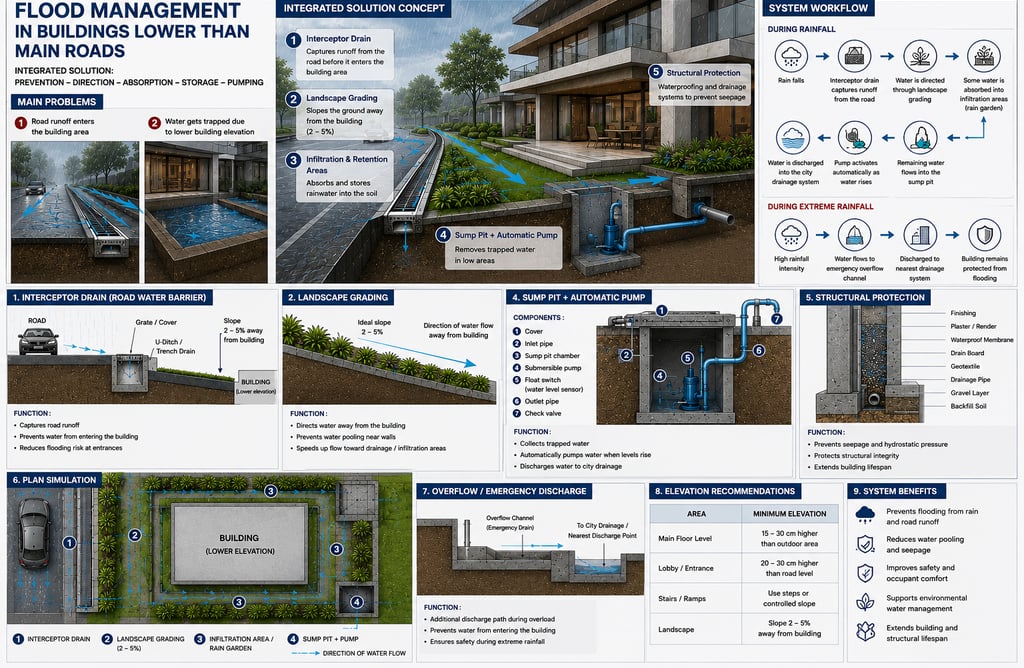
Buildings positioned below the elevation of adjacent main roads face a unique and persistent hydrological challenge. In these conditions, the site effectively becomes a “catchment pocket,” where gravity continuously drives surface runoff from higher public infrastructure into private building areas. During rainfall events—especially intense tropical storms—roads act as fast-moving channels, concentrating and accelerating water flow. When this flow meets a lower building edge, it creates not only direct inflow but also hydrostatic pressure that forces water through gaps, joints, and even porous materials. Over time, this repeated exposure leads to chronic issues such as seepage, rising damp, corrosion of reinforcement, degradation of finishes, and compromised indoor air quality.
To address these risks effectively, flood management must be approached as a multi-layered, integrated system rather than a single defensive measure. Each layer plays a specific role, and their combined performance determines the resilience of the building.
The first layer is prevention, which focuses on intercepting water before it enters the site. Interceptor drains or trench drains installed along the boundary between the road and the building serve as critical barriers. These systems must be carefully designed based on expected rainfall intensity, catchment area, and flow velocity. Proper sizing, sufficient slope within the channel, and regular maintenance (to prevent clogging by debris) are essential for optimal performance. In high-risk areas, these drains can be complemented with raised thresholds, flood barriers, or curb systems to further reduce direct inflow.
The second layer is direction, achieved through precise site grading and surface design. Rather than allowing water to move randomly, the site is shaped to guide it along predetermined pathways. This involves creating subtle but consistent slopes—typically between 2% and 5%—away from building structures, as well as integrating surface channels, swales, or hardscape contours. At this stage, architectural and landscape design must work together, ensuring that aesthetic elements such as pavements, green areas, and open spaces also function as hydrological tools. Poor grading, even by a small margin, can result in water stagnation and negate the effectiveness of other systems.
The third layer is absorption, which introduces a more sustainable approach to stormwater management. Instead of rapidly discharging all water into municipal systems, part of the runoff is retained and allowed to infiltrate into the soil. This is achieved through features such as soakaway pits, infiltration wells, rain gardens, and bioswales. These systems are particularly valuable in urban environments where impermeable surfaces dominate and natural infiltration is limited. By slowing down runoff and promoting groundwater recharge, they reduce peak discharge loads and mitigate downstream flooding. However, their effectiveness depends heavily on soil permeability, groundwater levels, and proper filtration layers to prevent clogging.
The fourth layer is storage, which temporarily holds excess water during peak rainfall events. Even with good interception and infiltration, extreme weather can produce volumes of water that exceed system capacity. Storage elements such as detention tanks, retention ponds, or underground reservoirs act as buffers, regulating the release of water over time. In smaller sites, this function is often integrated into sump pits or modular tank systems placed beneath driveways or landscaped areas.
The fifth layer is pumping, which becomes critical when gravity-based drainage is no longer sufficient. This is commonly the case in basements, semi-basements, or sunken courtyards where the discharge point is higher than the water collection area. A sump pit equipped with automatic float sensors and submersible pumps ensures that accumulated water is actively removed. For reliability, these systems should include backup pumps, emergency power supply, and alarm systems to handle power outages or mechanical failure during heavy storms.
Parallel to these layers is structural protection, which safeguards the building against long-term water exposure. Continuous hydrostatic pressure from surrounding soil and groundwater can lead to leakage through walls and slabs if not properly managed. Therefore, a combination of waterproofing membranes, protection boards, geotextiles, perimeter drains, and subsoil drainage systems is required. These elements work together to relieve pressure, channel water away from the structure, and maintain the integrity of the building envelope.
Importantly, the success of this integrated approach depends not only on design but also on construction quality and maintenance. Poor installation, insufficient compaction, blocked drains, or neglected pump systems can quickly undermine the entire strategy. Regular inspection and maintenance protocols are therefore essential to ensure long-term performance.
In contemporary practice, this holistic methodology aligns with global frameworks such as Water Sensitive Urban Design (WSUD), Sustainable Drainage Systems (SuDS), and Sponge City principles. These approaches shift the paradigm from simply “disposing of water” to managing water as a resource, emphasizing resilience, adaptability, and environmental balance.
By combining prevention, direction, absorption, storage, pumping, and structural protection into a cohesive system, buildings located below road level can effectively mitigate flood risks. More importantly, they can maintain operational continuity, protect asset value, and provide safe, comfortable environments even under increasingly unpredictable climate conditions.
Landscape Grading Application Simulation
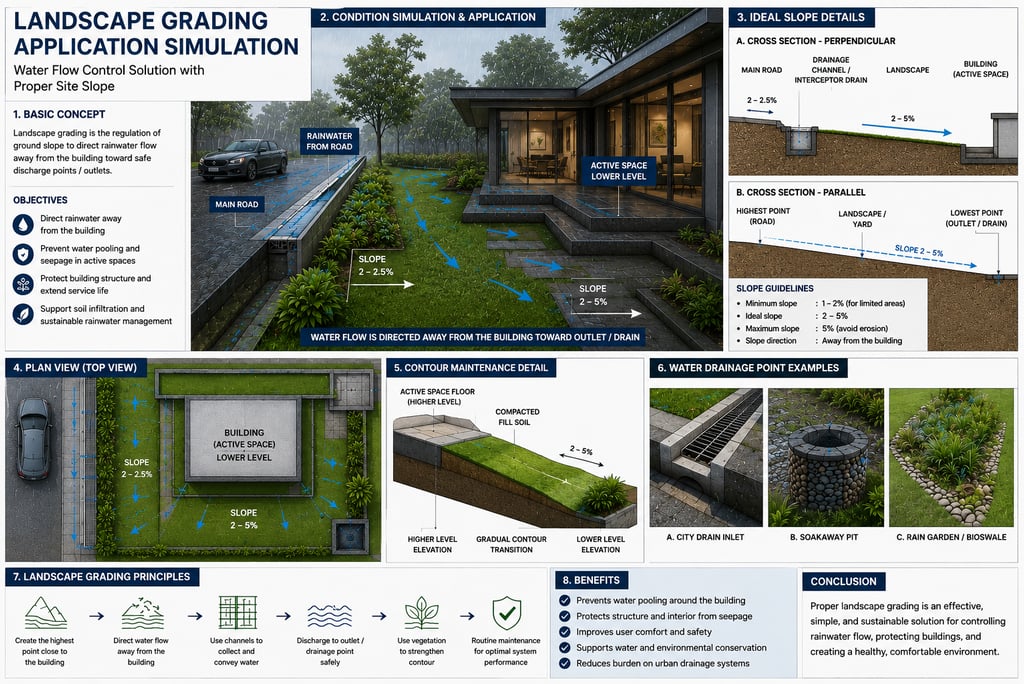
Landscape grading is a fundamental strategy in site design that controls how rainwater moves across a property. By carefully shaping the ground surface, water can be directed away from buildings and toward safe discharge points such as drains, soakaways, or infiltration areas. This approach is especially important in sites where the building sits lower than the surrounding areas, as improper grading can lead to water accumulation, seepage, and long-term structural issues.
The primary objective of landscape grading is to ensure that rainwater does not collect around the building envelope. Instead, water is guided along a controlled path using gentle slopes, typically between 2% and 5%, moving away from walls and active spaces. This not only prevents surface pooling but also reduces the risk of water penetrating floors and foundations. In addition, proper grading contributes to maintaining indoor comfort by minimizing damp conditions and humidity.
In practice, grading works in combination with drainage infrastructure. Rainwater from higher areas, such as roads, is first intercepted and then redirected through landscaped surfaces. The ground is contoured so that water flows naturally toward designated outlets like drainage channels, infiltration wells, or rain gardens. These systems allow water to either be discharged safely into municipal drains or absorbed into the soil, supporting sustainable water management and reducing runoff pressure on urban drainage systems.
A well-designed grading system also considers elevation transitions within the site. The highest points are typically positioned near the building, gradually sloping down toward the edges or drainage points. This creates a continuous and smooth contour that prevents abrupt level changes while maintaining effective water flow. Proper soil compaction and layering are essential to ensure stability and prevent settlement that could disrupt the intended slope over time.
Beyond functionality, landscape grading integrates with environmental and aesthetic considerations. Vegetation can be used to reinforce slopes, reduce erosion, and enhance infiltration capacity. Green elements such as bioswales and rain gardens not only manage water but also improve the visual quality of the site and contribute to ecological balance.
Ultimately, landscape grading is a simple yet powerful solution that protects buildings, enhances site performance, and supports sustainable design. When properly implemented and maintained, it reduces flood risk, extends the lifespan of structures, and creates safer, more comfortable outdoor and indoor environments.
Interceptor Drain Application Simulation
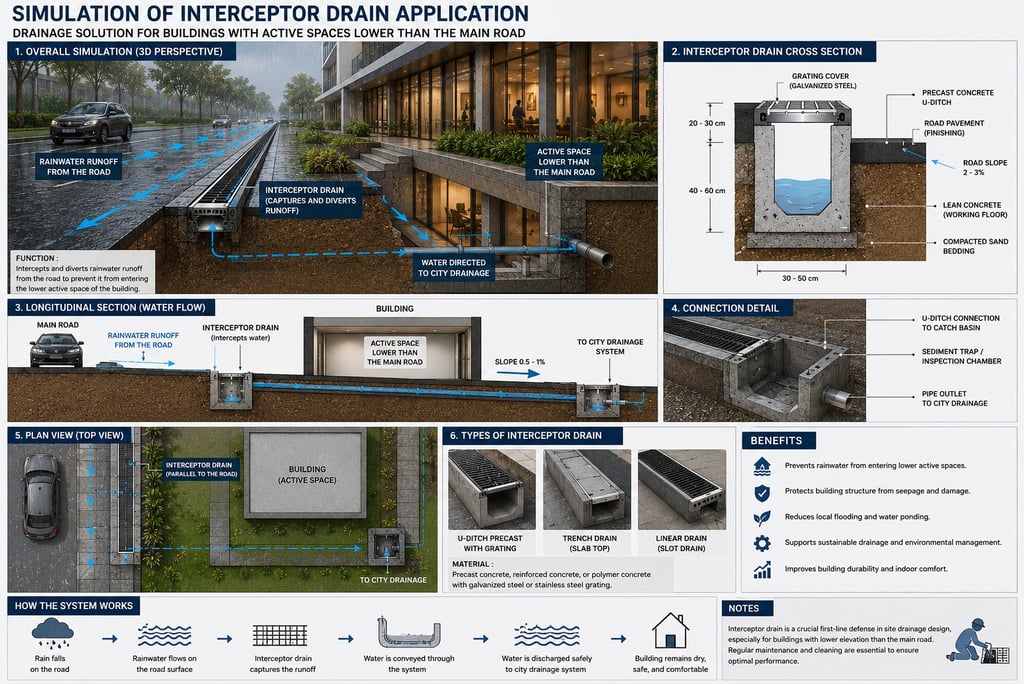
The implementation of an interceptor drain system represents a critical component in integrated flood mitigation strategies for buildings whose active spaces are positioned at elevations lower than the adjacent main roadway. In urban environments, this topographical condition creates a hydrological imbalance in which stormwater runoff generated on impermeable road surfaces naturally flows toward the lower building area due to gravitational forces. During periods of intense rainfall, the accumulated runoff can rapidly exceed the drainage capacity of the site, resulting in localized flooding, prolonged surface ponding, hydrostatic pressure against structural elements, and water infiltration into interior spaces. Consequently, buildings situated below road level are particularly vulnerable not only to direct flood intrusion but also to long-term deterioration caused by excessive moisture exposure, including material degradation, mold growth, corrosion of building components, and reduced structural durability. Within this context, the interceptor drain serves as an essential first-line defense mechanism designed to intercept, control, and redirect surface runoff before it reaches the building envelope.
Technically, the interceptor drain operates as a linear drainage infrastructure installed parallel to the boundary separating the roadway and the building site. Its primary function is to capture runoff water immediately after it leaves the road surface and channel it into a controlled drainage network. The system typically consists of reinforced precast concrete U-ditch channels or trench drains covered by galvanized steel grating that permits efficient water intake while maintaining safe pedestrian and vehicular circulation above the drainage line. In the illustrated application, stormwater runoff generated from the sloped roadway surface is directed toward the interceptor drain through controlled grading, preventing uncontrolled water movement into the lower active spaces of the building. Once captured, the water is conveyed through underground piping systems toward municipal drainage infrastructure, retention facilities, or infiltration areas, depending on the site’s hydrological strategy. This process significantly reduces direct hydraulic pressure exerted on the building perimeter and minimizes the risk of seepage through walls, floor slabs, and foundation systems.
The effectiveness of the interceptor drain is highly dependent on the integration of comprehensive landscape grading and surface water management principles. The surrounding landscape must be designed with carefully calculated slopes, generally ranging between two and five percent, to ensure that surface runoff consistently flows away from the building structure and toward designated drainage collection points. Through this grading strategy, the landscape itself functions as an active hydrological surface that guides, slows, and distributes water movement across the site in a controlled manner. This integrated approach not only prevents water accumulation near the building foundation but also reduces erosion risks and enhances the efficiency of downstream drainage infrastructure. Furthermore, the incorporation of sediment traps, inspection chambers, and maintenance access points within the interceptor drain system is essential for preserving hydraulic performance over time. These components prevent sedimentation, debris accumulation, and flow obstruction, all of which could compromise the system’s operational capacity during extreme rainfall events.
From an engineering perspective, the design of interceptor drains requires careful hydraulic analysis based on projected rainfall intensity, catchment area size, runoff coefficients, and peak discharge calculations. The dimensions of the drainage channel, including its width, depth, and flow gradient, must be proportionally designed to accommodate anticipated stormwater volumes without overflow conditions. Material selection also plays a fundamental role in ensuring long-term structural resilience. Reinforced concrete channels provide high compressive strength and durability under traffic loads, while galvanized or stainless steel grating systems offer corrosion resistance and structural reliability under continuous environmental exposure. In many contemporary urban developments, interceptor drains are further integrated with sustainable stormwater management systems such as infiltration wells, bioswales, rain gardens, detention tanks, and automated sump pit pumping systems. This combination creates a multi-layered water management network capable of simultaneously intercepting runoff, reducing peak flow rates, enhancing groundwater recharge, and managing trapped water in low-elevation spaces.
Architecturally and environmentally, the interceptor drain system contributes significantly to the resilience and sustainability of flood-prone developments. Beyond its immediate functional role in controlling stormwater intrusion, the system protects the integrity of interior spaces, prolongs the service life of structural components, and improves occupant comfort by reducing humidity-related problems within the building environment. Its integration into a broader sustainable drainage strategy aligns with contemporary urban planning approaches such as Water Sensitive Urban Design (WSUD), Sustainable Drainage Systems (SuDS), and Sponge City concepts, all of which emphasize adaptive water management in response to climate change and increasing urban flood risks. In rapidly urbanizing cities where impermeable surfaces continue to expand and rainfall intensity becomes increasingly unpredictable, interceptor drains are no longer viewed merely as technical drainage elements but rather as essential infrastructural components that support resilient, environmentally responsive, and sustainable urban architecture.
Water Infiltration Application Simulation
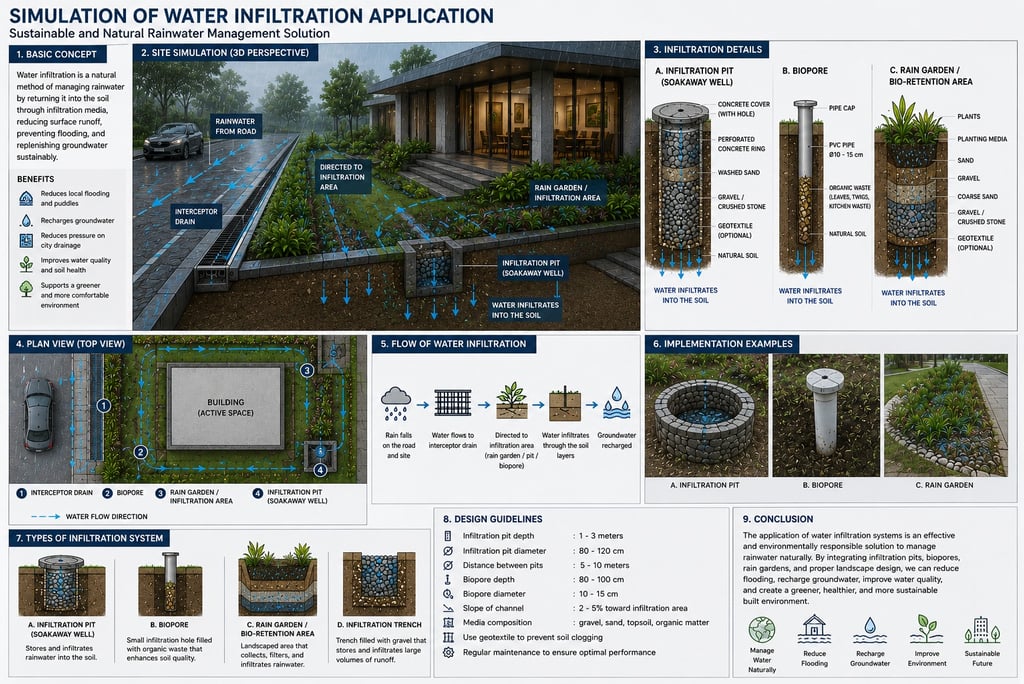
The integrated water infiltration system illustrated in this simulation represents a sustainable stormwater management strategy designed to reduce surface runoff, mitigate urban flooding, and improve groundwater recharge within built environments. In contemporary urban development, the increasing dominance of impermeable surfaces such as asphalt roads, concrete pavements, and dense building footprints has significantly disrupted the natural hydrological cycle. Rainwater that would traditionally infiltrate into the soil is instead transformed into rapid surface runoff, overwhelming municipal drainage systems and contributing to recurring flood events, erosion, and declining groundwater reserves. Within this context, infiltration-based water management systems have emerged as essential environmental infrastructure capable of restoring a more balanced interaction between urban development and natural water circulation processes.
The simulation demonstrates how rainwater runoff originating from the roadway and surrounding site surfaces is intercepted, redirected, and gradually absorbed into the ground through a network of infiltration components strategically integrated into the landscape design. Rather than treating stormwater as waste that must be rapidly discharged into municipal drainage infrastructure, the system approaches water as a valuable environmental resource that should be controlled, slowed, filtered, and returned to the soil. This approach aligns with contemporary sustainable urban drainage principles that emphasize ecological resilience, climate adaptation, and long-term environmental sustainability in urban architecture and infrastructure planning.
At the initial stage of the system, rainwater flowing from the road surface is captured through linear drainage channels or interceptor drains positioned along the site boundary. These drainage elements function as primary collection systems that prevent uncontrolled runoff from directly entering the lower active spaces of the building. Once intercepted, the water is directed toward designated infiltration zones integrated throughout the landscape. Controlled grading and topographical shaping of the site ensure that runoff water naturally flows toward these infiltration areas through gravitational movement. The surrounding landscape, therefore, functions not only as an aesthetic architectural feature but also as an active hydrological mechanism that regulates surface water movement and reduces hydraulic stress on the building environment.
One of the primary infiltration components shown in the simulation is the infiltration pit or soakaway well, which functions as a vertical subsurface storage chamber designed to facilitate deep percolation of stormwater into the surrounding soil layers. The infiltration pit is typically constructed using perforated concrete rings or structural retaining walls filled with coarse aggregates such as gravel and crushed stone to create void spaces capable of temporarily storing water. As stormwater accumulates within the chamber, it gradually infiltrates into the surrounding soil through natural percolation processes. In many applications, geotextile layers are incorporated to prevent soil migration and sediment clogging while maintaining long-term infiltration efficiency. This system significantly reduces peak runoff discharge and contributes to the replenishment of groundwater reserves that are increasingly depleted in urbanized regions.
The simulation also illustrates the application of biopore infiltration systems, which consist of narrow vertical cylindrical holes filled with organic waste materials. Beyond facilitating water infiltration, biopores contribute to biological soil improvement through the decomposition of organic matter by microorganisms and soil fauna. This process increases soil porosity and enhances the natural absorption capacity of the surrounding ground. Although relatively small in scale, biopore systems provide cumulative environmental benefits when implemented extensively across urban sites, particularly in residential landscapes, pedestrian areas, and green open spaces. Their simplicity, low construction cost, and ecological functionality make them an effective supplementary strategy within integrated infiltration networks.
Another critical component presented in the simulation is the rain garden, which combines landscape architecture with ecological stormwater treatment principles. Rain gardens are shallow vegetated depressions specifically designed to temporarily collect, retain, and infiltrate rainwater runoff from surrounding surfaces. The layered planting media, gravel base, and permeable soil structure enable water filtration while supporting vegetation capable of tolerating fluctuating moisture conditions. In addition to improving infiltration performance, rain gardens contribute to urban biodiversity, reduce surface temperatures, enhance visual quality, and improve microclimatic conditions within the site. Through evapotranspiration and biological filtration processes, these landscaped infiltration areas also improve stormwater quality before it enters groundwater systems or municipal drainage infrastructure.
Hydraulically, the success of infiltration systems depends on several engineering and environmental parameters, including soil permeability, rainfall intensity, groundwater table elevation, catchment area size, and infiltration capacity of the existing site conditions. Therefore, proper hydrological analysis and soil testing are essential before implementation to ensure that the system operates effectively under varying climatic conditions. Design dimensions such as infiltration pit depth, drainage channel slope, spacing between infiltration elements, and storage capacity must be carefully calibrated to accommodate projected runoff volumes during peak rainfall events. In areas with low soil permeability or high groundwater levels, infiltration systems are often combined with detention tanks, overflow drains, or automated pumping systems to prevent water stagnation and maintain operational reliability during extreme storms.
From an environmental and architectural perspective, the infiltration system presented in this simulation embodies the principles of resilient and sustainable urban development. By reducing dependence on centralized drainage infrastructure and restoring partial natural groundwater recharge processes, the system contributes to long-term water security, flood mitigation, and ecological balance within dense urban environments. Furthermore, the integration of infiltration infrastructure into landscape and building design demonstrates a shift in contemporary architectural thinking, where stormwater is no longer viewed solely as a hazard to be removed, but rather as a manageable ecological resource capable of supporting environmental regeneration and urban resilience. Through the combination of interceptor drains, infiltration pits, biopores, rain gardens, and controlled landscape grading, the system creates a comprehensive and adaptive water management network capable of responding to increasing rainfall intensity, climate change impacts, and the growing hydrological pressures associated with urbanization.
Contact
Reach out for bespoke design and build services
© 2026. All rights reserved.


Studio:
Jl. Pisang Kepok IV No. 24, Kota Baru, Bekasi Barat, Kota Bekasi 17133 - Indonesia
Headquarter:
Plaza Summarecon Bekasi, Lvl. 7
Jln. Bulevar Ahmad Yani Kav. K01., Harapan Mulya, Medan Satria, Kota Bekasi 17142 - Indonesia
Phone Number:
+62 817 0101 388
+62 821 2255 5520
e-mail:
glmindonesia19@gmail.com