
Affordable Housing with Tropical Adaptive Design to Reduce Urban Heat Effect
The climate-adaptive simple house represents a paradigm shift in tropical urbanism, moving away from energy-intensive conventional construction toward a holistic strategy that treats housing as a "breathing" thermal system. By integrating passive cooling techniques—such as cross-ventilation, high-albedo surfaces, and strategic shading—with micro-vegetation and low-carbon materials, these dwellings significantly reduce the urban heat island effect while ensuring interior thermal comfort.
5/8/20266 min read
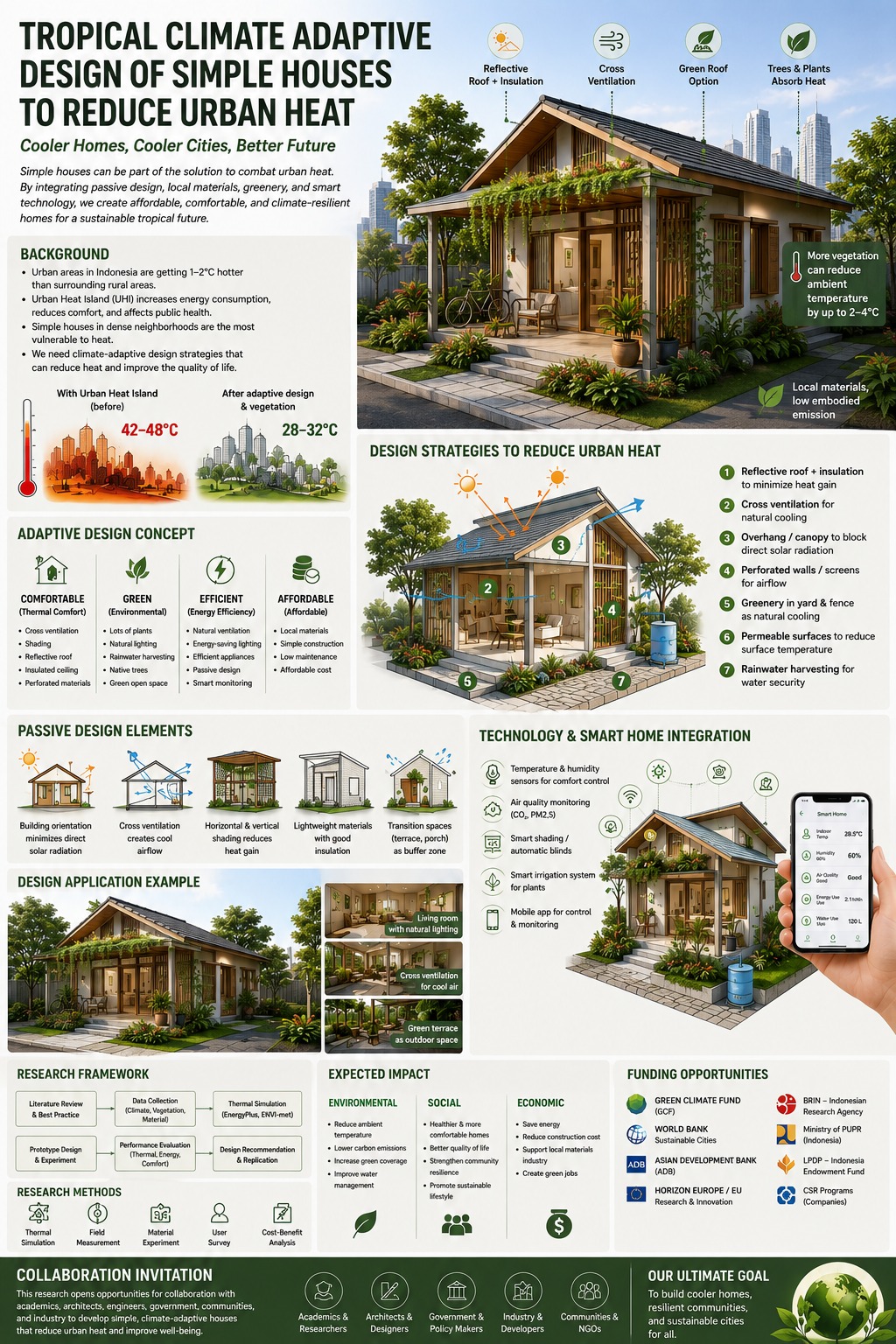
Simple House Design Adapted to Tropical Climate to Reduce Urban Heat
Urban heat, or the rising temperatures in urban areas, has become one of the main challenges in city development in tropical countries, including Indonesia. The growth of dense residential areas, limited green spaces, the use of heat-absorbing materials, and high building energy consumption all contribute to the urban heat island effect—impacting health, thermal comfort, energy use, and overall quality of life. At the same time, the demand for simple and affordable housing continues to increase alongside urban population growth. With growing global attention to climate resilience, sustainable housing, and net-zero development, research and implementation of simple, climate-adaptive housing in tropical regions hold strong potential to attract financial funding, international research grants, and green sector investment.
Cities in Indonesia are increasingly experiencing an “urban oven” effect. Concrete surfaces store heat like giant batteries, asphalt roads radiate high temperatures back into the surroundings, and dense buildings obstruct natural air circulation. This combination leads to rising urban temperatures, known as the urban heat island effect.
The urban heat phenomenon is no longer a future concern—it is a daily reality for urban communities. Rising ambient temperatures can lead to: a) Increased use of air conditioning; b) Higher electricity consumption; c) Rising carbon emissions; d) Reduced thermal comfort; e) Greater public health risks; and f) Increasing urban living costs.
In the context of Indonesia as a tropical country, this issue becomes more complex, as many simple and subsidized houses are still built using design approaches that are not responsive to the local climate.
Most affordable housing today faces challenges such as: a) Suboptimal natural ventilation; b) Limited natural lighting; c) The use of heat-absorbing material; d) High building density; e) Lack of vegetation; and f) Heavy reliance on mechanical cooling systems.
In fact, simple housing has strong potential to become a “passive cooling engine” for the city when designed with a climate-adaptive tropical approach. With the right design, simple homes can function not only as places to live, but also as instruments for mitigating urban heat, reducing carbon emissions, and improving overall quality of life.
Urban Heat and the Challenges of Tropical Cities
The urban heat island effect occurs when urban areas experience higher temperatures than their surrounding regions due to human activities and changes in land cover. The main factors contributing to urban heat include: a) The dominance of hard surfaces, such as concrete and asphalt; b) Limited vegetation and green open spaces; c) High building density that restricts airflow; d) Heat emissions from vehicles and buildings; e) Extensive use of air conditioning; and f) Building materials with high heat absorption capacity.
In tropical cities, the urban heat effect becomes more intense due to high solar radiation throughout the year and elevated humidity levels. This condition creates an urban heat cycle: Rising temperatures → Increased use of air conditioning → Higher energy consumption → Increased carbon emissions → Even higher urban temperatures.
If left unaddressed, urban heat can affect: a) Community productivity; b) The health of vulnerable groups; c) Household energy costs; d) Environmental quality; and e) Overall urban resilience to climate change.
Therefore, climate-adaptive design for simple housing becomes a key strategy in advancing sustainable urban development.
Key Principles of Tropical Climate-Adaptive Design
A. Cross Ventilation
Cross ventilation allows air to flow naturally through spaces, reducing heat buildup in the building. Design strategies are: a) Openings on opposite sides of the building; b) Window placement aligned with prevailing wind direction; c) Use of high-level ventilation; and d) Semi-open transitional spaces.
B. Shading and Solar Radiation Control
Direct sun exposure can significantly increase indoor temperatures. Control strategies are: a) Secondary skin; b) Canopies; c) Louvers; d) Roof Overhang; e) Shading Vegetation; and f) Proper building orientation.
C. Low-heat Materials
Building materials play a major role in heat absorption and release. Here is the list of the recommended materials: a) Lightweight brick; b) Engineered bamboo; c) Reflective material; d) Light-colored roofing; and e) Low-carbon local material.
D. Micro Vegetation
Plants act as natural cooling elements through evaporation. Application of this principle includes: a) Small garden; b) Vertical garden; c) Simple roof garden; and d) Shading tree.
E. Energy Efficiency
Tropical simple houses should maximize natural lighting while minimizing electricity usage. These include: a) Daylighting; b) Energy-efficient lighting; c) Small-scale solar panel; and d) Smart energy monitoring.
Simple Housing Design as a Solution to Urban Heat
Simple housing is often seen as a low-cost, mass-produced product. However, from a sustainability perspective, it holds strong potential to become a fundamental unit in transforming cities toward low-carbon development.
If thousands of simple homes adopt climate-adaptive tropical design, the impacts could include: a) Reduced ambient temperatures; b) Lower electricity consumption; c) Decreased carbon emissions; d) Improved air quality; e) Better public health; and f) Stronger urban climate resilience. In other words, simple housing is not merely a place to live, but a form of “micro climate infrastructure” for the cities of the future.
Potential for Integration of Technology and Smart Housing
Advancements in technology open new opportunities for developing tropical simple housing that is smarter and more efficient. Some technologies that can be integrated include:
A. Smart Environmental Sensors:
Temperature and humidity sensors help occupants understand the home’s thermal performance.
B. IoT for Energy Monitoring:
Internet of Things technology enables real-time tracking of electricity usage.
C. AI-Based Thermal Simulation:
Artificial Intelligence can be used to predict a building’s thermal performance and optimize its design.
D. Modular Green Housing:
Modular systems enable faster, more efficient, and flexible construction.
The combination of tropical architecture and digital technology presents a highly attractive area of research for: a) Green technology investor; b) Climate tech startup; c) International donor institution; and d) Smart city programs.
Opportunities for Financial Funding and Investment
Currently, sustainable housing and climate adaptation have become key priorities in global funding. Many funding institutions are seeking projects and research that demonstrate: a) High social impact; b) Contributions to emission reduction; c) Technological innovation; d) Scalability; and e) Real-world implementation.
A. Climate Resilience
Funding for climate adaptation solutions.
B. Green Building & Low Carbon Development
Funding for low-carbon development.
C. Affordable Sustainable Housing
Funding for affordable and sustainable housing.
D. Smart City Innovation
Funding for technology-driven urban innovation.
E. SDGs-Based Development
Funding aligned with the Sustainable Development Goals.
Why This Topic is Attractive for Collaboration
Research and implementation of climate-adaptive tropical simple housing are inherently multidisciplinary and open up broad opportunities for collaboration. This cross-sector collaboration can create an innovation ecosystem that not only produces academic research but also delivers practical solutions that can be widely implemented.
Academia:
a) Building thermal research; b) Energy simulation; c) Environmentally friendly materials; and d) Urban sustainability.
Government:
a) Subsidized housing policies; b) Green city programs; and c) Urban heat mitigation.
Construction Industry:
a) Material innovation; b) Modular construction; and c) Building technology.
Startups & Technology:
a) Smart housing; b) Environmental sensors; c) AI simulation; and d) Energy management systems.
Communities & NGOs:
a) Community empowerment; b) Environmental education; and c) Sustainable development.
Social and Environmental Impact
The implementation of climate-adaptive tropical simple housing has wide-ranging impacts.
Environmental Impact
A. Reduced Urban Heat:
Mitigation of the "urban heat island" effect, leading to cooler city temperatures.
B. Carbon Emission Reduction:
A decrease in the total greenhouse gases released into the atmosphere.
C. Energy Efficiency:
Optimizing power consumption to do more work with less energy.
D. Improved Air Quality:
Lower levels of pollutants and particulate matter in the air.
Social Impacts
A. Better Thermal Comfort:
Enhanced indoor and outdoor environments that remain at pleasant temperatures.
B. Lower Electricity Bills:
Direct financial relief for households through reduced utility costs.
C. Increased Quality of Life:
A general improvement in the standard of living and daily well-being.
D. Better Public Health:
Reduction in respiratory and heat-related illnesses across the population.
Economic Impacts
A. Long-term Energy Savings:
Sustained reduction in operational costs over the lifespan of a building or project.
B. Green Material Industry Opportunities:
New business prospects in the manufacturing and supply of eco-friendly construction materials.
C. Growth of Green Jobs:
Expansion of the labor market in sectors focused on sustainability and renewable energy.
D. Increased Sustainable Property Value:
Higher market valuation for buildings that meet green certification standards.
Simple Climate-Adaptive House Design for the Tropics
A climate-adaptive simple house is not merely an architectural concept; it is a forward-looking strategy for building cities that are healthier, low-carbon, and resilient to climate change. In an era of climate crisis and rapid urbanization, the development of simple housing must move away from conventional methods toward an approach that is more responsive to the environment, humanity, and technology. By integrating passive design, energy efficiency, low-carbon materials, micro-vegetation, and smart technology, simple homes can be transformed into tangible solutions for mitigating Urban Heat. This topic holds significant potential for financial funding as it sits at the strategic intersection of: a) Sustainability; b) Affordable Housing; c) Climate Adaptation; d) Smart Cities; and e) Social Impact.
Furthermore, this research opens vast opportunities for collaboration between academia, government, industry, green investors, and the community. The future of tropical cities may not begin with high-tech skyscrapers. Rather, that future may very well begin with a simple house that is capable of breathing in harmony with its climate.
Contact
Reach out for bespoke design and build services
© 2026. All rights reserved.


Studio:
Jl. Pisang Kepok IV No. 24, Kota Baru, Bekasi Barat, Kota Bekasi 17133 - Indonesia
Headquarter:
Plaza Summarecon Bekasi, Lvl. 7
Jln. Bulevar Ahmad Yani Kav. K01., Harapan Mulya, Medan Satria, Kota Bekasi 17142 - Indonesia
Phone Number:
+62 817 0101 388
+62 821 2255 5520
e-mail:
glmindonesia19@gmail.com